Happy Suffrage Anniversary today

RAISING CONCERNS: MaryScott Hagle, left, talks with developer Michael Ainbinder, right, about her concerns regarding the proposed Heights-area Walmart development during Wednesday’s public hearing at the George R. Brown Convention Center.

RAISING CONCERNS: MaryScott Hagle, left, talks with developer Michael Ainbinder, right, about her concerns regarding the proposed Heights-area Walmart development during Wednesday’s public hearing at the George R. Brown Convention Center.

90 years of talking back to power, ladies! 162, if you’re counting since 1848. And a bit of talking before that too. Voting adds to the effect.
Go MaryScott!
NY Times Op Ed connects suffrage fight to the contemporary scene
Wal-Mart Asks Supreme Court to Hear Bias Suit – involving more than one million female workers

Share

Pay for Delay

A program in the Satara district of the Indian state of Maharashtra pays newlyweds to wait at least two years before having their first child. (click for NY TIMES article)

Reproduction is a big issue in India, where the Times reports that roughly half of India’s population is under 25. That means they’ve got a big workforce, and a big group of people on track to start having kids of their own:

“… if youth is India’s [workforce] advantage, the sheer size of its population poses looming pressures on resources and presents an enormous challenge for an already inefficient government to expand schooling and other services. In coming decades, India is projected to surpass China as the world’s most populous nation, and the critical uncertainty is just how populous it will be. Estimates range from 1.5 billion to 1.9 billion people, and Indian leaders recognize that that must be avoided.”

Currently families in India average 2.6 kids, where 2.1 would sustain the current population level long term (it’s 2.06 in the US today). (Family planning generally happens after rather than before in India– where “many women [opt] for sterilization after their second child” — paralleling the US, where about 50% of married women are surgically sterile by the time they’re 40.)

Overall goal of the pay-to-delay program: to reduce population growth.
And the ripple effects extend much beyond the population cut.

Collateral upsides: the ladies get more education; down the line the kids they have later are more educated; then both the more educated moms and their more educated kids participate more robustly in the national economy. Dads benefit too when families are smaller and mom contributes more to the family income.

Further upsides: More educated women = more women’s voices are heard and more women participate in policy making.

The dynamic again parallels the US, where delay also leads to more education for women and to an increase in their participation in policy-making roles and in public discourse.

Unlike in China, no rules are set on the numbers of kids families may have under this program, but educated families tend to have fewer kids and to educate those kids more, due to increased means as well as increased awareness of educational ops.

In the US, delay of family is a common means of raising income – so as to have more to raise kids on when they do arrive. In the Indian program, the program adds a direct payment to the raised income that delay brings on its own.

Right now it’s a small program, but if it’s successful it may spread to other districts and states. Paying for delay at the front end could lead to big gains — social and individual — for the long haul.

Share

Thinking Globally about Adoption

Here’s a good piece on current issues in international adoption by EJ Graff, published in Democracy: The Baby Business.

She advocates requiring Hague accreditation for all international adoptions (instead of only enforcing the Hague guidelines for those countries that have signed on and allowing adoptions to continue from non-Hague countries with only very limited regulation), and outlines 8 holes that need plugging in order to make that happen.

Her article generated a lot of response from adoption experts, and those are accessible: here.

Share

Childlessness Up, Down and Steady: Parsing the New Pew Report

Childlessness and Later Fertility

Here’s another later-fertility story from the Pew Research Center. Last month they confirmed our suspicion that there are indeed more older moms around. This month they report that fewer women are having kids. Both reports resonate significantly with the recent 50-year anniversary of the birth control pill, confirming predictable outcomes.

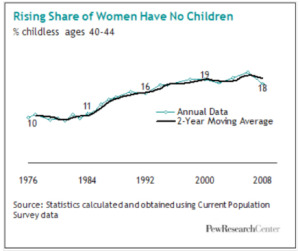
But the data are not entirely clear cut. For instance, the new report begins with an oddity. The headline reads “Childlessness Up Among All Women; Down Among Women with Advanced Degrees.” The lead sentence tells us that “Nearly one-in-five American women ends her childbearing years without having borne a child, compared with one-in-ten in the 1970s.” It turns out, they are comparing fertility data about women ages 40 to 44 across 30 years, and the “nearly one-in-five” is specifically 18 percent.

What’s odd is that the graph the authors provide (though not the discussion) indicates that the rate of childlessness in this age group in 2000 was 19 percent. pew So, it would have been just as correct for the headline to read “Childlessness Down Among All Women.” Or “Childlessness Fairly Steady For Past 15 Years,” since, as the graph also shows, the big rate jump occurred between 1984 and 1992, when the rate went from 11 percent to 16 percent. So that change is not exactly news.[1] Data are mobile, to paraphrase Rigoletto.[2] Since headlines are often all that people take in, care in contextualizing them is important, especially about key issues like fertility and family.

Another complication comes in the use of the word “childless.” The study looks at biological childlessness, and does not include step- or adopted kids. So its focus is on the biological productivity of children by women, not on their experience or construction of family. Many parents in the not-included categories would take exception to being called childless. That’s not what the study was about, it turns out, but the title is imprecise and the terrain is muddy.

And of course “childless” itself is a fraught term. People who choose not to have kids or who couldn’t have kids but don’t want to dwell on the fact often prefer the word “childfree.” As ever, data-mining can be a minefield.

As you will have remarked by now, there are many back stories in play here, especially on the explanatory front.

Causes of trend?

• A. Increase in Voluntary Childlessness: due to birth control, increased career options and lessened social pressure, increasing numbers of women and men choose not to have kids.
• B. Increase in Delay Leading to Infertility: due to those same factors and others, many women put off trying for kids until later and some of them wait too late to have kids with their own genetic material.
(The Pew researchers cite one study of 2002 data that found among those who defined themselves as never going to have kids, these explanations split the group about half and half.)
• C. Some Are Only Temporarily Childless: they will yet have kids – either as standard issue or via egg donation or egg freezing. This category isn’t dealt with in the study.

Fertility choices of women 40 to 44 today differ from their seventies counterparts’:
Point B morphs into point C when another premise of the study–that women ages 40 to 44 are at the end of their childbearing years–is put under the microscope.

There are at least two points at issue here:

1. That 44 is the end of fertility. That was a fair working premise for the vast majority of women until recently. But whereas in 1980 only 60 previously childless American women had their first babies in the 45+ range, in 2008 2,036 women in that age range had their first baby, 34 times as many (out of a total 7,666 babies born to women in this age group, up from 1,200).

Birthrate-wise that’s an increase from 0.0 to 0.2 births per thousand women ages 45 to 49 having a first birth and from 0.2 to 0.7 among women ages 45 to 49 overall.[1] It’s still a very small group, but it’s growing at a great rate. So the report operates under the cloud of a kind of a willed delusion. Yes, it’s true that most women who don’t have kids the usual way won’t have any, but it’s also true that women who have no kids through their mid 40s have a lot more money to spend on fertility treatments than their fecund younger sisters and increasing numbers will be successful. That money, and the cultural clout that goes with it, are part of the reason they waited. And this growing option should be part of the discussion.

2. That childless 40-year-olds in 2008 are as unlikely to have kids as their counterparts in 1978. They’re not. The use of 40- to 44-year-olds as a group with the same standard fertility prospects is very problematic because it’s physically untrue (one study indicated that roughly 66 percent are fertile at age 40, 50 percent at age 41, and then a quick downhill to 13 percent at 45).[4] In the past however, it may have seemed true, for social reasons. Back in the day there was a lot of pressure on women to marry and have kids young, so very few women who intended to have kids entered their 40s without any.

But now many women do delay their first child til 40 and beyond, and many of those women will yet have kids — which means they will leave the realm of the “childless” after their 40th birthday in larger proportion than women did in the past. And indeed, in 2008 the group of mothers 40 and up was the only group to buck the downward recessionary birth trend and show an increased birth rate (up 4 percent). This too should be part of the discussion.

There’s plenty more to say on all this, it’s complicated, and good data are hard to find– but this is the morphing world we live in and we have to keep track of lots of dynamics at once when talking about contemporary fertility, which is both highly politicized and highly personal. The Pew report offers a nice opportunity to open up the discussion of the realities of modern fertility, but let’s look hard at the data before we accept the headline analysis. There’s a lot still to be determined.

I’ll be writing on the education angle later.

This post appeared first on RH Reality Check.

[1] Interestingly, the CPS data seem to differ from the National Survey of Family Growth data cited in the Pew report’s footnotes, which gives 15% as the total childless figure for 2002 (6 percent voluntary, 6 percent involuntary, 2 percent temporary, 1 percent unaccounted for) and 12 percent for 1982. Abma, Joyce C., and Gladys M. Martinez. “Childlessness Among Older Women in the United States: Trends and Profiles.” Journal of Marriage and Family, 68:4. (2006).
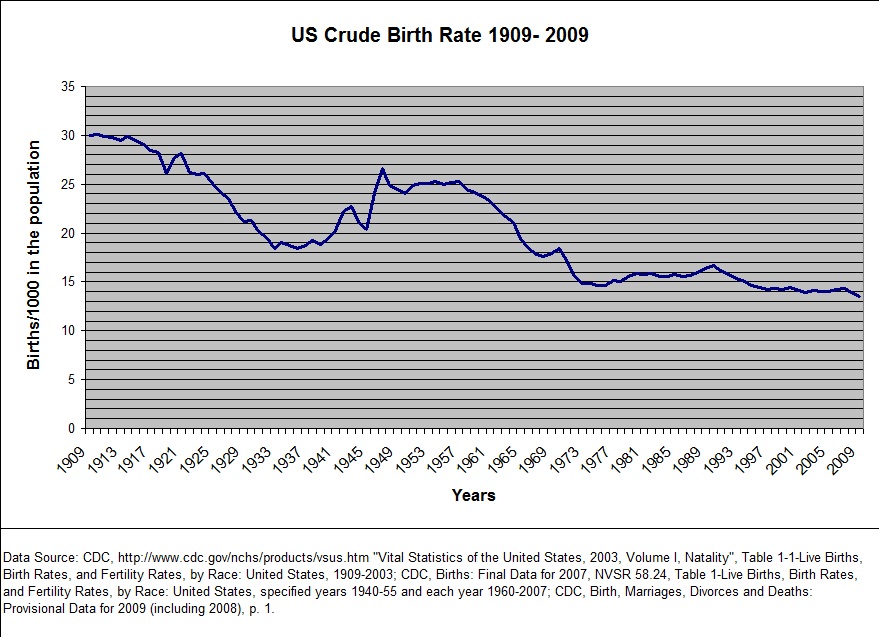
[2] It would be interesting to see a graph of this trend for the whole 20th century – it’s been so up and down on the fertility front. Expanded graphs often enrich the story, but the data is not always available.
[3] Though women 50-54 are also included in the numerator since there are so few.
[4] They are linked here because that’s the way the statistics are gathered, in five-year groups.

Share

What’s it worth to you?

What’s a Mother’s Work Worth to You?

Here’s one of those stories that tells you what the work you’re doing at home would be paid if you had to hire someone else to do it. The work done was based on time-use reports by 28,000 moms. This is presumably supposed to tell us something about the value of this work, but it’s a pretty shifty business.

Stay-at-home moms by this account would get $117,856, and moms with outside jobs would earn $71,860 above their regular salary. Overtime is a big factor in these calculations — so if you were looking to save on your equivalent (the cost of having someone else do it), you’d just hire two people to split the jobs and the salary would drop substantially.

If you have kids, is this kind of report consoling or depressing to you? And why?

If you’re thinking about kids, how does this kind of report affect your thought process?

Do the big numbers emphasize the big value of mom’s work, or do they emphasize the long hours and the amount she’s actually underpaid? Does it seem like a rigorously defined data point, or a dubious exercise to begin with, underlining the big disparities in pay scales in the real world for people who work in care industries and those in the “professional” world where this kind of salary actually gets paid.

The assumption seems to be that you would hire someone from the big economy to do the jobs — but the evidence is that a middle class woman could easily hire another woman (or two) for much less than this to take over the majority of her functions, and many people do. The poor are always with “us” — because “we” hire them at reduced wages. They’re in the kitchen, the nursery, and the garden, and in equivalent “unskilled” positions around town.

Of course a big part of the job of mothering is about what someone else couldn’t or wouldn’t do–that special extra value that “only a mother” can add. And specifically about evading the paid economy. If cash payment was required, a lot of this work wouldn’t get done, because few people could afford it. Family is another word for venture capital, of both monetary and non-monetary kinds. For lots of reasons, some economic, some sentimental, motherhood as we know it is all about NOT getting paid.

These salary numbers remind me of the ads that invite you to save huge amounts on things you don’t need by buying now, to which you respond with your own calculation about how much more you’re saving by not buying at all. There’s something wrong with the premise here too, to do with the fact that incommensurate systems of valuation are being linked here (paid work vs. unpaid; men’s pay scale vs women’s pay scale), but we’re pretending they’re commensurate.

Instead of estimating the value of a mother’s work in terms completely foreign to the reality of what real moms or their surrogates in the world of housework are paid, better to work toward fixing the field within which these values are determined. We could start by improving moms’ real ability to work for a fair wage and to not lose ground on pay scale when they have kids, whether or not they step out to care for them for a while. Likewise, the lack of a national system of decent, affordable childcare — available to about 10% of workers today –is a big part of why many people stay home actively NOT earning $117,856. Pay equity. Childcare. Those are the values that would make a real difference to many moms today.

Pay equity for female workers would offer more options to families of all classes (with one parent or with two) to choose how they want to structure their workloads and their care arrangements, especially if good childcare, part time or full time, wasn’t so expensive.

A national childcare program could involve some compensation for moms who decide to stay at home with their kids (think “child allowance”). Kids are, after all, not just their private indulgences but the nation’s future citizens, and worth some national investment.

Bottom line: we need more upfront discussion of the real-world economics of childrearing and of women’s work than fantasy numbers like $117K invite.

Share

Thinking ahead?

Here’s a NY Times piece I was interviewed for, re older moms and the Pew study — which turned out to focus on the fact that if you’re a later mom you’ll also likely be a later grandma and maybe not see your grandkids if your kids have kids later too. This is not my worry, but hey, to each her own.

For me, it’s one of those unpredictables–currently I’m more concerned about the long-term effect of the local oil spill. My take is eat healthy and have fun now. And get to the gym regularly – I missed the gym part last few months and now, having returned, I’m very sore! But not for long.

Share