International Women’s Day #99 / Moving forward

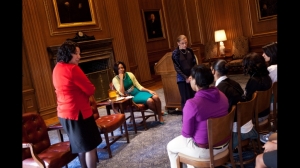
IWD started back in 1911 – and a lot has changed in the interval. There’s plenty yet to do, but many more women now work in places where they can get the message out. Like India Gary-Martin (b. in Ohio, now a senior banker at RBS in London and President of the City Women’s Network)

India Gary-Martin Discusses Women in Senior Business Roles

“If [business] people don’t make it happen, then the government has to make it happen. … We should be able to make it happen without legislation.”

The time for positive change is always now.

Share

25% of Iraqi Seats Must Go to Women

That’s 82 seats.

From <em/>Sisters in War: A Story of Love, Family and Survival in the New Iraq” title=”christina_asquith” width=”300″ height=”196″ class=”size-medium wp-image-450″ /><p id=From Sisters in War: A Story of Love, Family and Survival in the New Iraq

Hear more on the story from journalist and author Christina Asquith on NPR.

Then ask yourself how this connects to the United States, where currently 17% of the seats in Congress are held by women, with no guarantees on continuation.

There’s growing global sentiment for recognizing that women’s interests and insights are ignored when they’re not at the public-policy-making table (see French Gender Quotas piece, for example).

When / does the “no legislation without representation” concept hit home? While many elements differ in the US and Iraqi scenes, is the basic dynamic essentially different? Calling Lani Guinier?

Share

The End or a Shot in the ARM?

Earlier this week Andrea O’Reilly announced the closing of her Association for Research on Mothering at York University in Canada, effective May first, due to lack of funding from York.

The sudden closure could mean the end to a long and productive series of conferences and publications on issues related to mothering around the globe. But ARM’s supporters are working to turn things around, with a new facebook page and a fundraising effort.

“Motherhood is such invisible work and ARM made it visible,” notes one supporter in the Toronto Star.

Will the mothers save the ARM? Stay tuned….

Share

Budgetting for Childcare – the Big Picture

The current federal budget discussion includes several moves toward expanding access to good, affordable childcare.

Not only would this access improve our national education outcomes and women’s ability to go to work, earn full-time salaries and benefits (instead of being ghettoized in low-paid, reduced-benefits part-time work).

In addition IT WOULD CREATE JOBS — in the centers. Good jobs, with benefits and a decent wage. Since those jobs would be in GOOD childcare situations, they would require skilled workers, which would lead to further increase in educational levels, this time for those seeking to fill those jobs.

Win win. In discussing the benefits of childcare, it’s key to keep all these linked effects in mind and in the discourse. Childcare = improved EDUCATION for kids, HIGHER lifetime WAGES for the women workers whose kids are in the childcare and for their families, more access to health care for families, improved education for the teachers, and many new good, unexportable JOBS (if expanded to full access for all who want it, hundreds of thousands of such jobs).

Related post: Childcare as Infrastructure: Minting the Common Wealth

Here’s a summary of what’s been proposed by the Obama adminstration, from the National Women’s Law Center:

• A $1.6 billion increase for the Child Care and Development Block Grant (CCDBG), to a total of $6.644 billion. This would be the largest increase in funding for the program in more than 20 years. The increase would include $800 million in discretionary funds (which are appropriated on an annual basis do not require a state match) and $800 million in mandatory funds (which require a state match). Mandatory funding would be adjusted each year for inflation after FY 2011.

The additional funding for CCDBG would allow for an increase in funding set aside for quality improvement activities, to $373 million (from $271 million), of which $137 million would be for activities that improve the quality of infant and toddler care (up from $99.5 million previously). The set-aside for child care resource and referral and school-age activities would be increased to $26.09 million (from $18.96 million). Funding for the Child Care Aware toll-free hotline would remain at $1 million.

The Administration proposes to use the additional CCDBG funding to support a reauthorization of the program that would encourage the establishment of a high standard of quality across child care settings, expansion of professional development opportunities for the child care workforce, and coordination among early childhood education programs.

• A $989 million increase for Head Start and Early Head Start, for a total of $8.2 billion. Head Start would serve an estimated 971,000 children, an increase of approximately 66,500 children over FY 2008, and Early Head Start would serve approximately 116,000 infants and toddlers, nearly twice as many as were served in FY 2008. This allows for the increased number of Head Start and Early Head Start children funded by the American Recovery and Reinvestment Act (ARRA) to continue.

• Approximately $9 billion over 10 years for a new Early Learning Challenge Fund, similar to the amount included in a bill passed by the House last year and that will be debated by the Senate. The initiative would make competitive grants to states to improve the quality of early learning programs to help children enter kindergarten ready to succeed.

• A $10 billion increase over 10 years for child nutrition programs to support their reauthorization, including the Child and Adult Care Food Program.

• An $87 million increase, to $1.3 billion, for U.S. military child development centers to expand availability for affordable, high-quality child care services at over 800 centers both in the United States and overseas.

• An increase of the Child and Dependent Care Tax Credit for families earning $115,000 and under. Families earning $85,000 and under would be eligible for a tax credit equal to 35 percent of child care expenses, with the percentage phasing down to 20 percent at $115,000. However, the credit would not be made refundable, so families with little or no federal tax liability would receive little or no benefit.

At the same time, funding for several other child care and early education programs would be frozen at existing funding levels, consolidated with other programs, or eliminated:

• Funding for Individuals with Disabilities Education Act (IDEA) Part C Grants for Infants and Families and Part B/Section 619 Preschool Grants would remain at $440 million and $374 million, respectively.

• Funding for Child Care Access Means Parents in School (CAMPIS), a competitive grant program supporting the participation of low-income parents in postsecondary education through campus-based child care services, would remain at $16 million.

• Funding for 21st Century Community Learning Centers, which supports before- and after-school opportunities for children, would remain at $1.166 million.

• A new $250 million Striving Readers literacy program would consolidate a number of existing programs into a comprehensive birth through high school literacy grant program. Fifteen percent of funds that state educational agencies subgranted to local agencies would have to be used for serving children birth to kindergarten age. Even Start would be eliminated as a separate program.

*Note: Proposed funding levels for FY 2011 are compared to FY 2010 funding levels excluding any additional funding provided through the American Recovery and Reinvestment Act, unless otherwise noted.

Share

Adoption think

Nice adoption trip post by PunditMom — and a series of good ones on Haiti from Adopt-a-tude. Harlow’s Monkey is an ongoing source of critical reflection on the world of international adoption from the perspective of an adult adoptee.

Adoption is complicated, as these blogs attest. Respect, personal and cultural, is the best foundation–and the world’s understanding of the dynamics of adoption (international, in-country, transracial and not) and of the effective responses to the needs of orphans and kids whose living parents can’t provide for them are evolving quickly. No easy answers but lots of room for the hard work of love and real family support.

Share

Madame Mayor: Why So Rare?

Houston Mayor Annise Parker

Houston Mayor Annise Parker

Here’s my op-ed on lady leaders, in Sunday’s Houston Chronicle (also on HuffPo):

http://www.chron.com/disp/story.mpl/editorial/outlook/6877420.html

While the headlines have rightly focused on the gay breakthrough, Annise Parker’s ascension to the mayor’s office also makes Houston the biggest U.S. city with a substantial history of female leadership.

Progress, in my view. Just more liberal BS according to the Chronicle commentors! But the most trenchant critique came from my friend Liz who was pretty sure that she didn’t say “Heck.”

Madame Mayor: Why So Rare? (My title, theirs did not rhyme) 

When Houston elected Annise Parker in December and became the biggest city yet with an out gay mayor, a lot of us got surprised comments from out-of-towners: “Who knew Houston was a liberal town?” cheered my friend Liz in Philadelphia. “We’ve never elected a gay mayor! Heck, we’ve never elected a woman — and neither has New York or L.A.!”

The headlines, rightly focused on the gay breakthrough, have elided that second amazing fact. Parker’s ascension also makes Houston the biggest U.S. city with a substantial history of female leadership. Today, of the 50 biggest U.S. cities, only three have women mayors. That’s three. Along with Houston, there’s Baltimore and Fresno, Calif. By comparison, six states currently have female governors, and women hold 17 percent of the congressional seats. Not big numbers, but more than the mayors.

Thirty of the 50 biggest cities have had a female mayor at some point (Seattle, the trailblazer, elected one in 1926), 12 have had more than one (the biggest of those are San Antonio, Dallas, San Diego and San Jose, Calif.), and 20 have had none. That’s 40 percent.

Chicago, the third-largest city, elected a one-term woman mayor 30 years ago. Phoenix, now the fifth-largest city, inaugurated a two-termer in 1976.

By the time those two left office, Houston had its first woman mayor, too. Kathy Whitmire stayed in office for 10 years (through 1991), along the way appointing the first African-American police chief (Lee Brown), and when he left for New York, the first female police chief of a major U.S. city (Elizabeth Watson), and the first Latina to be chief judge of the Houston municipal courts (Sylvia R. Garcia, now a Harris County commissioner).

What difference does a mayor’s gender make? Though it might seem progressive in itself, female leadership (like gay leadership) doesn’t guarantee progressive policies (see Wasilla), nor does it guarantee good behavior (see Baltimore), any more than male leadership does. But politics as usual transforms in positive ways when women of all political stripes participate: More citizens’ perspectives are represented (a plus in a democracy), and once many women populate the field, nobody can run as “the woman candidate.”

As it happens, women leaders often do introduce change, both because they know some things from experience that their male counterparts do not (like the need to support families and workers) and because they’re often able to see the possibility of stepping outside established patterns, as with Whitmire’s appointments.

Why do so few women run? Because they aren’t often asked, and, when they are elected, the insistently masculine political culture chases many of them off. Women’s low rate of participation in business leadership roles (just 3 percent of Fortune 500 CEOs are women) also affects political participation, since the two often intersect.

But Parker comes to office in Houston in a context of active female policymakers. Houston City Council is about half female, the highest proportion of any big city. The University of Houston has an entrepreneurial female president (its second). And while the business leadership is overwhelmingly male, inroads are sometimes made, here as elsewhere.

Women are not at parity in Houston, but this year we’ve moved a bit ahead in the slow trickle up that has characterized the national progress of women in government and business over the past 30 years. Because nationally the family support infrastructure hasn’t changed (good affordable child care is still only available to a few), women all over haven’t been able to move in sufficient numbers into positions where they could change it. But women are building toward the critical mass that changes the dynamic.

Is Houston a liberal town, as my friend now thinks? Well, sometimes. This politically and socially diverse city has elected effectively Democratic mayors for the past 12 years — but the area is also home to George H.W. Bushand Tom DeLay. The city’s history as a wildcatting town, open to people making their own fortunes, along with the relative brevity of its big city status, means that on many fronts there are fewer social barriers here than in apparently more progressive places.

Is Houston a business town? Pretty much. Not surprising that in a recession the nation’s energy capital, a teeming metropolis with growing numbers of citizens to employ, would elect the candidate who presented herself as most fiscally conservative and responsible, open to innovation where appropriate and with a proven track record as city controller and council member.

“I’m going to be the mom telling you to eat your vegetables and you don’t get dessert. I’m trying to make sure you have enough food to eat,” Parker told the city the day after the election. In hard times, the frugal housewife saves the farm. Mom as fiscal disciplinarian.

Not the metaphors the headlines might have led the nation to expect, but not a surprise in Houston, where Parker’s been out so long her sexual orientation turns out to be immaterial. She’s been with the same partner for 19 years. Her kids are well-behaved. Pretty ordinary stuff, even boring compared to the high jinks the straight politicians entertained us with last year. So why not put to use the skills and knowledge she’d developed on our dime in her last 12 years in office? The voters turn out to be more open-mindedly pragmatic than the pundits expect.

Parker’s election throws down the gauntlet to all cities to expand their resource base by actively advancing more women and minorities through the public service and business leadership pipelines — and then drawing on that experience and electing them mayor. Regularly. While firsts in all categories (gay, black, female, Latino, Asian) are important, it’s the seconds, thirds and so forths that give real traction to change.


Share

Pushing Babies: The Assault on Childless Women

Childless women of all ages are under assault in America. If you’re a teenager, you’re pushed toward motherhood by “moralizers” bent on denying you information about, and access to, birth control. If you’re a women 35 and older, you’ve been subject to a decade of news stories set to the ominous sound of a ticking clock and bent on creating fertility anxiety–if you wait, you’ll be too late. Recently the anxiety peddlers have been expanding their targeted danger zone to include women in their late 20s and early 30s. “Women lose 90 per cent of ‘eggs’ by 30,” ABC news and others informed us lately, and the message was more of the same: get busy!

We have abstinence-only ed to thank for the recent upswing in the teen birth rate, a job assisted by the glamorization of teen moms in the media and of babies in the tabloids and the reality TV shows. Of course the glamour fades fast, and teen moms face big problems. Plummeting high school graduation rates for the moms, and later for their kids. High likelihood of poverty. Small hope of a long-term relationship with, or support from the father. Those are personal problems for the girls and their families, but they’re also national problems as our hope for a globally competitive, educated work force goes south. Education reform not linked to real birth control information doesn’t just leave kids behind, it actively sets them and all of us back.

And sure, older women need to know that fertility declines with age. But what are the actual fertility rates of women in each age range? And why is it that increasing numbers of women choose to delay in the first place? What is lost when they don’t? Instead of facts and understanding of the causes and effects of delay, we get a lot of sentimentality aimed at getting you to start your family now.

When you consider that 2007 saw an upturn in the birthrate in every age category between 10 and 45 as US births hit an all-time high, there’s a clear disconnect between the high rates of birth for women 35 plus and the claims of the anxiety peddlers. Women seeking full fertility facts should know that the only rigorous study of natural fertility rates (conducted in the 1950s from data collected over years prior) indicated that the infertility rate was 3.5 percent at 25, 7 percent at 30, 11 percent at 35, 33 percent at 40, 50 percent at 41 and 87 percent at 45. (Click here for more on the 1950s data.) Of course individuals differ, no one group is generalizable to all other groups, and data from the first half of the twentieth century wouldn’t reflect fertility degradation that may have occurred from STDs, stress or pollution. But indications are that health and medical advances have improved, not lessened, our natural fertility rates within these age bands. However you understand the relation of this study to the present moment, the rate of decline is nothing like what is suggested by a story with the headline women lose 90% of eggs by 30, implying a similar percentage likelihood of infertility.

In addition, IVF, egg donation, adoption and egg freezing have expanded women’s options after their natural fertility goes. But while these often work, they are expensive and unpredictable. And, hard though it may be to imagine in our baby-wild world, many women are happy without kids. They’d be even more likely to be happy if they weren’t being reminded all the time of how unhappy they should be. But instead of a real look at women’s life options, we get a sentimental, inaccurate and incomplete narrative.

As for that report on 30-year-olds’ remaining eggs – though the report implies that low egg reserve means a low fertility rate, a closer look at the data makes clear that there is no link. The abstract only cites figures for 30- and 40-year-olds (12 and 3%, respectively), but the full report makes clear that women of all ages have a hugely diminished reserve when compared (as they are here) to the number of eggs a female fetus has at 20 weeks past conception! According to these figures, 25-year-olds, generally understood to be at the height of their fertility, have only 22%, 20-year-olds a mere 37%, 15-year-olds just 52%, 10-year-olds all of 70% and 5-year-olds about 87%. Since few women are infertile at 30, apparently 12% is all you need.

What’s left out of all these stories is why women wait. To get an education. To earn a decent wage so they can afford good child care and have enough clout to negotiate a flexible schedule that they wouldn’t otherwise get. To find the right partner for the long term. To mature and maybe see the world. All of these are good reasons. And in fact the average age at first birth of college-educated US women of all races is 30.

It is when those reasons for waiting are ignored that everybody loses. The lack of good childcare systems and flexible schedules means many college-educated women who become mothers, like teen moms, are locked into limited career paths that ensure long-term low wages and a limited voice in business and public policy creation (while 50% of middle managers are women, just 17% of Congress is and 3% of CEOs). Women and their families lose out when women’s wages are low, when divorce is inequitable, when careers are “mommy tracked.” The nation loses when the education and insights of half its citizens go unused.

Circularly, because the national family-support infrastructure hasn’t changed, women have been unable to move in sufficient numbers into positions where they could change it much. What progress has been made on this front has been entirely due to women’s having delayed kids (by a few years or by many) or not had them at all. If women are pushed to start their families earlier through false or incomplete information, even that progress will erode.

Because fertility is experienced as a very personal issue by everybody, it ends up getting very little critical discussion, and that’s a big problem since many women then end up with bad information on which to make life-shaping decisions. Time for an honest exploration of the dynamics of birth timing and women’s work, especially in our recession. That would be a fertile discussion.

This originally appeared on RH Reality Check, and later on Huffingtonpost.com

Elizabeth Gregory directs the Women’s Studies Program at the University of Houston and is the author of Ready: Why Women Are Embracing the New Later Motherhood (Basic Books, 2008). She blogs about the politics and economics of motherhood and women’s work at www.domesticproduct.net

The piece below, on fertility anxiety and the Hutterites, provides some
background for the 1950s study mentioned in the piece above.

Share