
Hutterite Fertility Data and Modern Fertility Anxiety

Part of the background to the current confusion about how long fertility lasts is the fact that there is very little good data. (Related stories: A B C)

As I noted in Ready, nobody knows exactly at what rate fertility declines today or if it’s the same average rate all over, because doctors can’t mandate that a big group of people have unprotected sex constantly for the sake of an experiment. Most people use some form of birth control unless they are trying to get pregnant (including restraint and withdrawal as well as pills, condoms, etc.).*

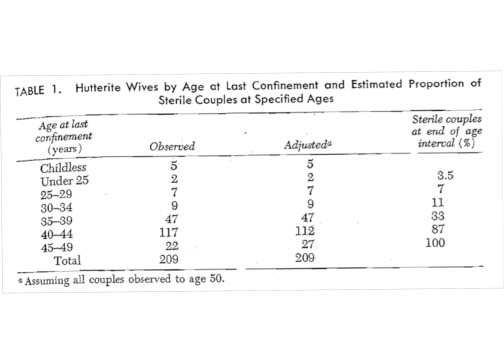
The closest thing to a thoroughly controlled experiment of women’s fertility so far involved a Protestant religious sect called the Hutterites, pre-1950. The Hutterites of the period essentially tried to have as many kids as they could, year in and year out, as a religious duty, and the community supported all children equally so having more didn’t draw down the family resources. A study based on Hutterite data indicated that the infertility rate (deduced from when each woman had her last confinement) was 3.5 percent at 25, 7 percent at 30, 11 percent at 35, 33 percent at 40, 50 percent at 41 and 87 percent at 45. Thirteen percent of them had their last baby between 45 and 49, and nobody had a baby after 49. The average woman in this group had eleven babies! (And unlike in the general population, the women tend to die earlier than the men.)

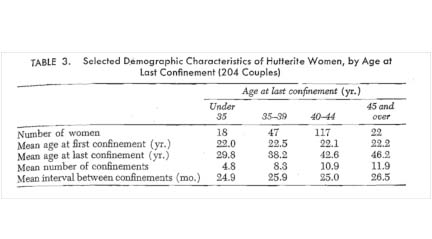
For your reference, here are the relevant charts from Christopher Tietze’s report on the study, with some background info:
table1-ct

“[The] report is based on the histories of 209 Hutterite women who married prior to the age of 25 years, married only once, and who were living with their husbands at age 45.Three out of 4 women in this group, 151 in all, were observed in the married state up to or beyond the age of 50 years, while the remaining 58 were observed to some point between 45 and 50 years of age.

“Of the 209 women in the study, 5 had no children.A sterility ratio of 2.4 per cent is low but not extraordinary, considering that the average age at marriage was 20.7 years.The remaining 204 women had experienced from 2 to 16 pregnancies excluding those terminating in fetal death.The total number of confinements was 2009, corresponding to averages (means)_ of 9.6 per woman and 9.8 per mother. These 2009 pregnancies resulted in 1989 single births and 20 pairs of twins. “

The “adjusted” column estimates “the number of additional confinements that would have occurred if all women had been observed to age 50” (based on the percentage among those who were).

C. Tietze, Table 3, "Reproductive Span and the Rate of Conception among Hutterite Women," Fertility and Sterility 8 (1957): 89-97.

C. Tietze, Table 3, “Reproductive Span and the Rate of Conception among Hutterite Women,” Fertility and Sterility 8 (1957): 89-97.

Table 3 looks at the statistics on age at last confinement (or birth) for the group, not including the 5 women who had no confinements.

These infertility numbers may have been low relative to the general population at the time, and they may be low now, but we can’t prove that because the records of any group of people today would be skewed by the many forms of birth control in use. Besides that, unless people are impelled by a religious enthusiasm like the Hutterites, there’s no way to guarantee that even a totally “natural” population won’t skew the data by simply exercising restraint in the bedroom at the prospect of too many children.

One researcher I spoke with noted that, given that no rigorous studies have been done on fertility in women’s forties, it’s also possible that the onset of age-based infertility might have occurred earlier among the Hutterites than it would among the rest of the population, due to the wear and tear on the women’s reproductive systems from having had so many babies. But there is no direct evidence of that.

While we can’t prove through equivalent studies that contemporary wombs are (or your womb in particular is) more or less fertile than the wombs of the Hutterites, there is no reason to think that the effect of age on fertility is any worse now than it was 100 years ago.

Some recent results do corroborate the general trend of the Hutterite study for women 35 to 39.  Data collected at seven European natural family-planning centers in the late 1990s (the European Fecundability Study) indicate that about 90 percent of women not already known to be infertile due to pre-existent issues like endocrinal disorders or surgery who try to conceive between ages 35 and 39 will become pregnant within two years.  That’s if they use natural family-planning methods (charting temperature and cervical mucous to more accurately predict when ovulation happens and to shorten time to conception) and have sex at least two days per week. [1]  Roughly 82 percent will become pregnant within one year.[2]

Is Infertility on the Rise?

The many stories circulating about fertility problems and treatments may give you the impression that the incidence of infertility is rising. A 2013 CDC report says that infertility has actually declined in the past thirty years. If you’re confused about fertility, it’s probably because you’ve been paying attention—the messages out there are mighty mixed.

Though the use of fertility treatments is rising, there’s no evidence that the intrinsic span of women’s fertile years has changed much over time. While advancing treatment options can expand the span for some, the blockage of fallopian tubes brought on by pelvic inflammatory disease or endometriosis can impair it for others. Then there’s the male infertility element.

So if women aren’t more infertile now than in the past, why are the numbers of visits to fertility doctors rising? In part because more people start trying for children later in life, at ages when fertility rates have always been lower. In addition, more fertility treatments are now available so more people seek them out, and there are more fertility doctors.

That last item may seem to argue circularly. But while the rise in the number of fertility doctors responds for the most part to a rise in demand (caused by the first two points on that list), it is also a response to the potential for profit in this area. Fertility clinics are an enormous boon to the infertile, but they are, after all, businesses as well—as Debora Spar points out in her book The Baby Business—and businesses seek to expand the market for their services where possible. The reigning mood of fertility anxiety encourages women to visit doctors at the slightest sign of difficulty.

Doctors need customers (the average fertility clinic needs to perform three hundred to four hundred IVFs at about $12,000 each to break even, and most are run for profit). Spar explores the complexity of the current fertility market—noting that, while doctors do work to get their clients good results, they may also profit from prescribing treatments that have a great likelihood of failure (like IVF for women who are unlikely candidates) but which couples will step up to pay for, sometimes repeatedly, because they live in hope. Sometimes the couples won’t take no for an answer, even when doctors try to dissuade them. And, of course, there’s always a chance that it will work, though that chance might be slight.

Doctors may also profit from prescribing unnecessary treatments to women in their mid-thirties who are driven to their offices by the anticipation of failure—some of them will really need help, and some of them might well get pregnant if they kept trying a little longer.

The tangled dynamics of the current fertility scene jumble together the parents’ desire for a child and the doctors’ and the pharmaceutical companies’ joint motives—both to assist potential parents and to make a profit. Some people are infertile early, and it’s hard to say firmly who fits that description, so it’s hard to blame doctors for taking an aggressive route. But we might hope they would avoid fanning the flames of anxiety and work instead to develop and convey clear information on fertility.

Sometimes they do the opposite, as seems to be the case with the kind of reporting involved in the recent story that “Women lose 90 per cent of ‘eggs’ by 30.” The headline implies a big fertility decline at 30 (a suggestion affirmed in interviews with the researchers) even though the data involved, on ovarian reserve, tell us nothing about the real rate of fertility of women at 30 or any age. In fact, in 2007, women 30 and older had 1,575,515 babies – more than one third of the babies born in that year. Keep that in mind the next time you read a scare-mongering infertility headline. Fertility does decline with age, but the point of onset of the decline does not itself decline at the clip suggested by such “studies.” In planning our family and work narratives, we’ve all got to take all the things that matter to us into account, and do our own research.

For more on this and related material, see Ready: Why Women Are Embracing the New Later Motherhood.

*A woman gets diagnosed as infertile when she and her partner have been trying consistently to conceive for a year, without success (barring a male infertility issue). Infertility is not the same as sterility, so infertile women might very well have children with technological assistance—or more trying. And then different people “try” with more or less efficiency, and that’s hard to gauge in a really rigorous way.

Share

“Not that YOU Look Old…”

This week I’ve posted a guest blog on the morphing aesthetics of aging today, at the Women’s Review of Books site Women=Books, hosted by the Wellesley Centers for Women:
Not that YOU Look Old…”: On Later Motherhood

Please stop in, and feel free to leave a comment if you have thoughts on the matter.

Women’s Review of Books also has a Facebook page that posts the link.

Yours in transit!
eg

Share

Reader’s Question: Can Working Parents Go Green?

Motherhood seems like a basically ecological undertaking. People who spend time feeding and nurturing the young can be expected to take an interest in keeping the food pure, the parks pleasant, and the air breathable. The very act of giving birth is itself all about recycling – moving the DNA of the forebears forward into the next generation. So it makes sense that many moms embrace the green movement, cutting waste and emissions to work toward sustainable ways of living.

But for some moms, however much they might wish that it were otherwise, going deep green feels next to impossible. Because they’re busy! I’m not talking about the ones who hustle through their days cooking, cleaning and composting – though I know some ladies who do just that. Those ladies (and a few gents) have the weekly soup simmering on the back burner and the specialité du jour on the table when the family sits down. But that’s a different kind of busy.

I’m talking about the moms with the 9 to 5, and the kids in the backseat at 6 wailing for a meal NOW! Those are the moms who bring home the Styrofoam so much more often than they (aka I) want to. And the plastic, and the metallic peel-off tops. Whose children’s bodies incorporate too many French Fries and hormone-heavy hamburgers. How many working parents’ families are sustained by the unsustainable? And is there a way out (besides quitting the job and living on roots and berries in the countryside)?

You know there is! And it’s not rocket science. It’s easy in concept – though it may be harder in actuality to break the bond with convenience (which is, after all, a kind of addiction).

In the packaging realm, the answer is simple: bring your own bin. If you can reuse a paper shopping bag, or carry your own cup to Starbucks, you can bring your own Tupperware to the burger shop. Yes it’s plastic, but you already have it. This behavior does require some planning – you have to have the bin clean and ready in the car when you get there, and you can’t go to the drive through—you have to park, walk in and hand your container to them when you order. So try it. If they won’t take your bin, you have to walk out. Find another shop where they’re not so hidebound. Given enough bin-waving customers, they’ll all adjust. In the meantime, it might help to think of it as an adventure on behalf of the planet. And your children’s sense of the importance of life’s details.

The harder part is relying less on the fast food to begin with, which either means buying more high-end take out (not an option for many, especially in recessionary times) or cooking it yourself. Which of course involves more than chopping and stewing – the shopping and the planning can double the time investment. Getting us all to the place where we make time to do this, and where we think it’s worthwhile, will involve a big cultural shift–to a Frenchified world where both employers and workers see food and family time as important. Of course this shift is well underway in the world of local farmers’ markets, cooking show fanaticism, and the slow food revolution.

This is not yet the world of the working moms I know however–and quite a few of the part-time or stay-home moms chose that route precisely because they wanted somebody to have time to do the cooking. This makes home cooking a luxury for the well off, and it means that for many the two sides of the “women’s work” spectrum — home arts and climbing the ladder in the paid work world, to a point where business policy might be reshaped — are directly opposed. Because time is limited.

But do they have to be opposed? I remember my own working mom poring over piles of cookbooks every Saturday planning the weekly menu and shop. Some weeks we’d get lots of spaghetti — but we also got a good variety of basic healthy vegetables and simple meat dishes, lots of casseroles in winter, and the occasional soufflé (not hard, once you’ve tried it a few times). Part of making it work is prioritizing cooking. And when there’s really no time for that, the other part is the bin in the car.

Working mom shopping co-ops could help — or websites with one week’s recipes with prefab shopping lists beside them (okay, I’m fantasizing here, and they’d all be good recipes with ingredients everyone in my family likes). Next step, getting the kids involved in the cooking –or in just making sure the bin is washed and ready to go in the morning. And there’s always the Crock Pot . . .

Related story: How Green Is Your Takeaway Container?

Share

Could Gender Quotas Change Our Looks?

Here are two stories from Forbes: one tells us that, surprise, looks matter for women in terms of promotions (thinner, taller, confident, dressed-up women make more on average). The story does not address the way looks affect the promotions of men — except in the case of height. Does that mean there is no link for men on weight and appearance?

The second story offers more on the French gender quota proposal covered below — this one with a few more details on who gets onto boards of directors in the US, and why.

Putting the two stories together lets us wonder–would looks matter any less for women if there were more women in positions of power? Sure, looks do affect our perceptions of everybody, maybe especially in leadership roles, so people –male or female — who don’t attend at all to appearance would tend to be passed over for those jobs. But looks on their own do not a leader make, as our national undying loyalty to Oprah signals, whatever her shape of the moment. In fact it’s Oprah’s ongoing struggles with a body with its own opinion on what looks good that draws us to her and creates a dynamic of mutual empathy — and understanding that while standardized looks may entice us, they aren’t what finally matters.

Paying attention to grooming while projecting a confident attitude (the way to fulfill one version of attractiveness) is not the same as spending enormous amounts of time at the gym, refusing all sweets, or signing up for surgery. While looks count more for ladies in a world of male power, if power were equalized, women might feel less pushed to focus so much on appearance (and self-criticism) and have more time for developing their good ideas. Looks-wise, we’d likely get a range of leaders as a result — some svelte, some not so svelte; but they’d all have something interesting to say. And maybe the rest of us could relax a little as well.

Share

Gender Quotas: The Wave of the Business Future?


Gender Quotas: The Wave of the Business Future?
Following up on his plan to move beyond the GDP to more adequate measures of national well being that include unpaid care work (see Sept 21 post), French President Nicholas Sarkozy has proposed a new plan to advance gender equity: a scheme to impose gender quotas on French boards of directors in order to achieve parity, since it just wasn’t happening without them.

The Guardian reports:

“In a bill submitted to the French parliament this week, all companies listed on the Paris stock exchange would have to ensure female employees made up 50% of their board members by 2015. If passed, a gradual implementation of the law would see businesses obliged to have women in 20% of board seats within 18 months, and 40% within four years.”

In a related move, in 2000 France changed its constitution to promote gender equity in politics,* but currently, the Guardian reports, “only 18% of MPs in the lower house [of the French Parliament are] women.” This parallels the 17% of Congressional seats held by women in the US.

In the U.S., though women hold more than 50% of managerial positions, only 15.2% of directors seats on corporate boards are filled by femmes. Only 3% of US corporations have female CEOs (Ursula Burns, above, is one). Though boards presumably seek the most able appointees, the old-boy network still has strong hold and able, qualified women are being overlooked. Without a strong incentive, established boards of directors have not actively sought to bring in points of view that might challenge established business practice.

But after the recent business collapse in the US and beyond, it’s clear that old ways of doing business are not serving us well — and that new viewpoints are badly needed.

If the French proposal passes, observers doubt whether the board quotas will be met on schedule, since the political quotas have not been. But no change is possible if no attempt is made. Is it time for the US to start thinking along similar lines?

*”The French Constitution was reformed in 1999 to state that “the law favors the equal access of women and men to electoral mandates and elective functions.” In 2000, French law was changed so that political parties must present equal numbers of men and women (within two percent) for most elections. In 2007, socialist Ségolène Royal (see above) stood for the Presidency, but lost with 47% of the vote to conservative Nicolas Sarkozy.” (International Women’s Democracy Center)

Share

Emotionally Correct Food*

Thanksgiving Day is Mother’s Day – in reverse! It’s the day when the Mother (or the nourisher/s, of whatever age or gender) works hard and long to fulfill the family’s core fantasies of care and good eating. Primal stuff. This works even if it’s you by the stove, channeling the nourishers of your past. Or if the cook at your feast is no relation.

*Thanks to Cathy Boswell for this phrase

Share

Women 50% of the Workforce — What Changes?/TV

Because the recession has laid off more men than women (75% of jobs lost were men’s jobs, in arenas largely staffed by men like manufacturing and construction…), women by default are about to become 50% of the paid workforce for the first time. Not exactly an advance, since we’ve made the gain while standing still. Time Magazine and Ms, following the lead of Maria Shriver’s A Woman’s Nation Changes Everything report, have both taken this as an occasion to examine gender and workplace issues–always a good thing if it can move us along further in our discussion of how to make the workplace fairer.

Here’s a link to a discussion of some of these issues I was part of on Houston PBS earlier this week.

In reality, women have always been 50% of the workforce. So far hitting 50% of the paid workforce has only been the occasion to remind us that we’re the underpaid 50% — where before we were just the unpaid 50%. Will that evidence be enough to get change moving?

Share