Gender & Work Update

24gender-gr-tmagArticle-v2
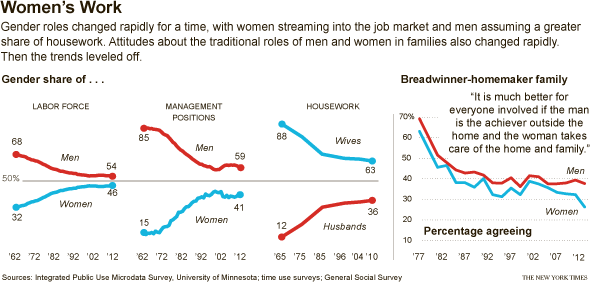
Here’s a lively summary of the last 50 years of change in the gendering of work & the recent lack of change in the rates of women’s participation in the paid work world, by sociologist and blogger Philip Cohen (familyinequality.wordpress.com):

Cohen particularly focuses on the need to move men into traditional “women’s work” to balance out the move of women into traditional “men’s work.” That would be key to re-valuing all the necessary tasks — but part of that would also mean paying (both women and men) more for that historically underpaid (or unpaid) family labor.

He does feature the need for more support for childcare at the close – along with reduced work hours and paid family leave. I’d of course put even more emphasis on the need to expand access to good, affordable care for all families, from 3 months on and mimicking the full time work schedule (8:30 to 5:30, 12 months of the year).

See also: LEAN ON: Expand the School Schedule & Raise GDP
Fair Pay, Fertile Future

Share

Lean ON: Expand the School Schedule & Raise GDP

We_Can_Do_It!My new piece on the Daily Beast makes two arguments:

  • the current national school schedule forces women out of the work stream,
  • and women can use the clout we’ve amassed to date to change things now.

Though the mismatch of school and work schedules is obvious, it’s not much mentioned, if at all, in discussions of how to change the dynamics of women’s work to allow more women to  stay at work full time and gain the benefits of that “reliability” (like an end to the gender pay gap and a greater chance to move up into the C-suite where they could evolve policy further to meet the needs of 21st century families).

Instead of focusing on making parent’s work schedules “flexible” in order to accommodate school, let’s reverse the picture and make school more consistent, to accommodate work.  This proposal also has the major benefit of providing early childhood education to the huge proportion of our children currently in bad care or at home with parents who cannot provide them with the resources they need to enter Kindergarten ready to learn.

Of course the proposal will raise hackles.  Kids are in school too much already, not too little, some will insist.  They need more efficient teaching, not more time…. Any school schedule change is a tinder box — here, as in France.  Since thinking about one change reminds us of our huge set of inadequacies in the education realm, it’s generally easier to let the status quo stand.

But if you actually want to solve problems, you have to address them.  Expanded school days could be organized to provide a range of activities, not just standard class time (including homework, sports, arts, play, and tutoring time).

These all would involve expanded costs, and there are a range of means of paying for them — which would need debate. For starters: The additional taxes (payroll, sales and property taxes) brought in from the increased wages earned by the women who return to or never leave work once this schedule starts, could cover much if not all of the additional costs. Any remainder could be made up through sliding scale payments and expanded education investments by the state, the municipality and the feds. What will no doubt soon become our chastened and responsible Congress can hammer out the details.

Of course startup funds would be required to build a nation’s worth of good childcare facilities, to upgrade extant school buildings for summer operations and to train a few hundred thousand skilled childcare and preschool teachers. But these jobs would create their own economic stimulus, putting money into the pockets of construction workers and teachers, who would spend it in their communities. The long-term positive economic effects of improved education for the nation’s children and of their mothers’ new freedom to build solid careers would be enormous.

The investment in children’s education would result in across the board benefits: to the economy, to the nation’s ability to innovate to meet emerging challenges (of which there are so many), and to the quality of citizen’s lives.

The way to get this done?  Women have to step up, and use the power they’ve accrued over the past few decades of struggle in the workplace.

Enough with the debates over whether or not we need to “lean in” to overcome internal obstacles that hold women back at work.  Enough with complaints that change will only come when a woman is elected president.  Time to focus on putting our existent muscle to work to lean on business and government to evaporate the many external obstacles to women’s and children’s success within our work and education realms as currently structured.  We can do it. 

Share

Older Women Having More Kids, Younger Women Still Having Fewer

Fertility Rate Stabilizes as the Economy Grows” — read the NY Times headline last month, over its report on the on the CDC preliminary report on births in 2012.  They went to explain both that “an improving economy encouraged Americans to resume having babies” and that “[t]he number of babies born in the United States in 2012 remained flat.”

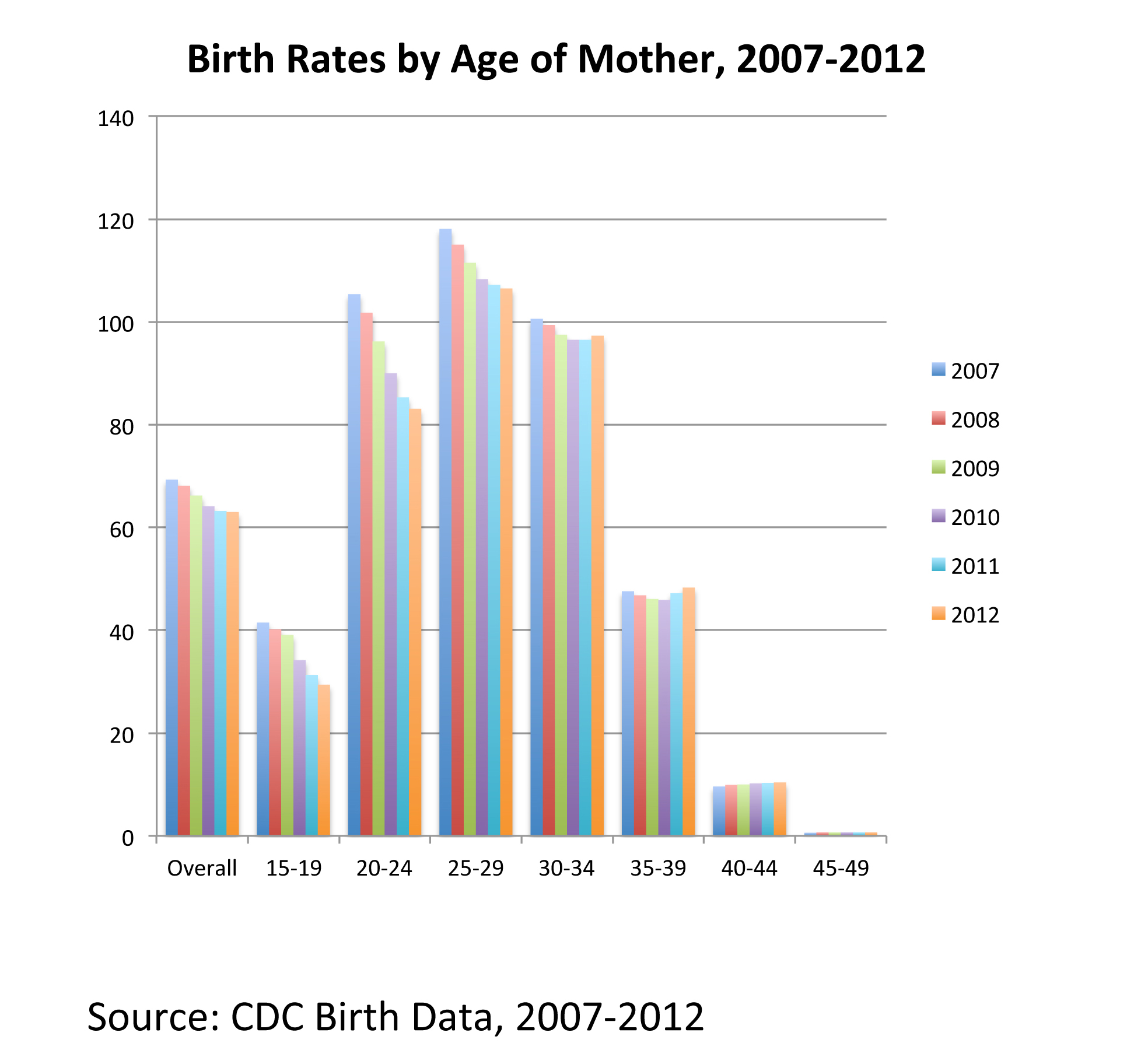
The first statement is partially true – the group of people who “resumed having babies” is women 30 and over, while women 29 and under were still having fewer than ever.  The second statement is pretty much true – the rate declined only marginally.  The 2012 rate is nevertheless the lowest ever recorded in the US, coming in at 63.0 births / 1000 women aged 15-44, as opposed to the earlier all-time low, 63.2 in 2011.

Here’s a visual to give a sense of how the overall decline continues at the lower end of the age span, and has swung up a bit at the far end:

Birth Rates by Age of Mother, 2007-2012.pptx

As you can see, the rates fell in all groups but those 40+ at the start of the recession, but have since begun to swing up again among women in their 30s.

Since 2007, the rate for women 15-19 fell 29%, the rate for women 20-24 fell 21%, for women 24-29 the rate fell 10%, for women 30-34 it fell 3.3%, including the 1% rise between 2011 and 2012.  The rate for women 35-39 fell initially but rose in the past two years, for an overall gain since 2007 of 1.5%. The rate for women 40-44 never fell, and has risen 8.3% since 2007.  Rates for women 45+ stayed steady.

The Total Fertility Rate (the total number of children the average woman would have at the current rate) fell to 1.88—a bit below the replacement rate of 2.1.  But because the large part of the decline is among younger women, there is good reason to expect that rate to rise, if they follow the time-lag pattern of delayers before them, who’ve had children once they completed their educations and established in their careers.  Provided, of course, that the economy continues to improve.

Here’s another chart, representing the actual birth numbers by age of mother, rather than birth rates, in lines rather than columns —  since 1996.

births by age of mom, 1996-2012

Following up on the rate info above, the changes in the numbers of births by age of mother between 2007 and 2012 are as follows:

1-14 the numbers have fallen by 2,521 / 15-19 down by 139,479 births /20-24 down by 165,486 / 25-29 down by 84,398 / 30-34 up by 51,542 /35-39 down 27,708 / 40-44 up by 4,356.

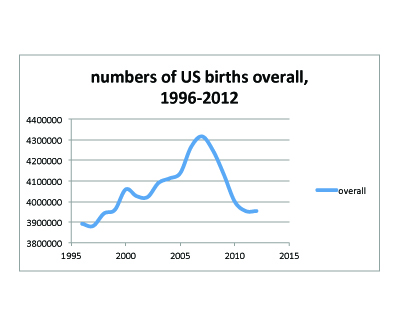
Since different numbers of people appear in each age group each year, the number can go down even though the birth rate goes up (as with the 35-39 year olds), and vice versa (as with the 30-34 year olds).  Likewise a group that starts with a fairly low number of births can have a big percentage rise, but show a low gain in actual numbers (as with the 40-44 year olds).   When a group with big numbers has a big rate fall, you do see a big decline – so the total decline in births between 2007 and 2012 is 363,295 (there were that many fewer births in 2012 than in 2007, which was itself unusually high).

Numbers of births overall

Share

The Myth of the Childless Generation?

5799715281_bb6e0dc6ce_oMy new post is up on the Atlantic.com, in response to recent stories on the rise of childlessness in America: here.

Though there are substantial numbers of  women 40-44 without kids, reported high rates of childlessness are premature.   They fail to take into account late fertility, adoptions,  and the time-lag effect of  childbirth delay.  The reports may prove true in the long term, or they may not—but it’s too soon to tell. ….


Share

Texas Woman Suffrage, Minnie Fish & Moving Women’s Equality Forward

Today is Women’s Equality Day – the 93rd anniversary of the passage of the 19th amendment to the US constitution.  My op-ed in today’s Houston Chronicle.
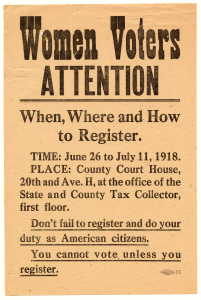
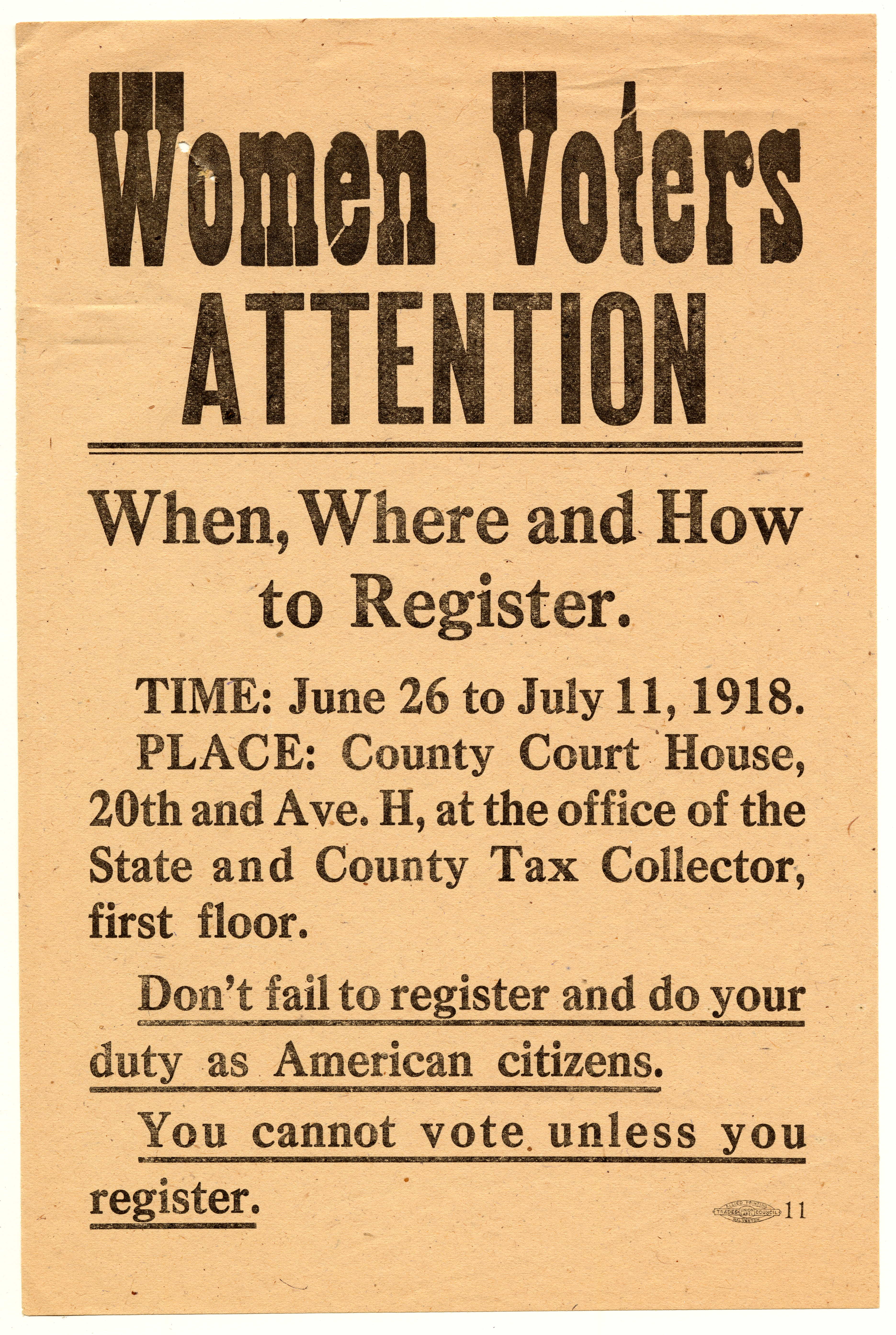
Women Voted in Texas in 1918 - from the Carey C. Shuart Women's Archive & Research Collection, UHouston

Women Voted in Texas in 1918 – from the Carey C. Shuart Women’s Archive & Research Collection, UHouston

How about full equity by the 100th anniversary in 2020?

Women’s suffrage Texas-style

Ninety-three years ago, when the 19th Amendment to the U.S. Constitution granting women the vote passed on Aug. 26, 1920, it was old news in Texas. Back then, Texas was at the forefront of positive political change for women; lately, we’ve had some setbacks.

In 1920, women had already been voting in Texas for two years, since Texas Woman Suffrage Association president and New Waverly native Minnie Fisher Cunningham and her co-agitators in 1918 had won women the right to vote in primaries. As the Democrats dominated Texas at the time, voting in the Democratic primary meant women had their say in state politics. As with any group, voting supplied the only means by which female citizens’ interests would be represented in policy-making.

In 1919, Cunningham was recruited by the National Woman Suffrage Association to lobby Congress, and her efforts paid off not just for her state but for her nation. Soon after, women won the national vote, and “Minnie Fish” as she was sometimes known, was among the founders of the national League of Women Voters.

Minnie Fish’s activism was born of bold ideas and hard experience. In 1901, she’d become one of the first women to receive a degree in pharmacy in Texas; she worked as a pharmacist in Huntsville for a year, but, finding that she made half what her male counterparts did and having other options, she quit, noting later that the inequity in pay “made a suffragette out of me.”

As we know, even after women got the vote, the pay-equity problem didn’t disappear; it’s still causing controversy here and nationally. Pay discrimination by gender became illegal in 1963, but that law has no teeth because there’s no oversight mechanism to ensure that people are paid fairly (in many businesses, it’s a firable offense to ask your coworkers what they’re paid) or for punishing in state court those who pay women less.

The recently vetoed Texas Lilly Ledbetter law didn’t directly require evidence that employees were paid fairly; it gave women the right to sue if discrimination was discovered to have occurred for more than 6 months after it began. But even that limited recourse seemed too threatening to some businesses. Will pay inequity make activists of enfranchised 21st-century Texas women, as it did with Minnie Fish? Stay tuned.

Fertility Politics

Terms like “woman suffrage” sound antique today, but the issues debated 93 years ago are very current. Though they may seem separate, reproductive rights, economic rights and voting rights are intimately linked and affect whole families, not women only.

Texas still is at the feminist forefront in some respects. For example, while neither New York nor Los Angeles has ever had a female mayor, and Chicago had one for one term in the early ’80s, Houston has had one for 14 of the past 32 years. But in other respects, we’re losing ground.

The 2011 cuts in poor women’s access to birth control through the drastic reductions in funding for the Women’s Health Program in Texas is predicted to result in thousands of unplanned births in the next year, at a cost of millions to taxpayers. Likewise, the expansion of “safety” rules in abortion clinics will drastically cut reproductive health services of all kinds to poor women across the state. Pharmacist Minnie Fish would not be proud of us. Unplanned births increase poverty levels by drawing young parents away from their educations into lifetimes of multiple low-wage jobs to support their kids, who themselves may repeat the cycle, and reduce the state workforce skills level when increased skills are needed.

When women who already have all the children they want are denied access to reproductive services, all the members of their families suffer. Older children’s hopes are diminished as each unsought new arrival depletes the resources of the group. And their parents, being busy and often uninformed about civic issues, are less likely to vote.

As Minnie Fisher Cunningham knew almost a century back, “social issues” (aka, women’s lives) are serious political and economic stuff. As proud heirs to the fairer world she helped realize, it’s the responsibility of Texans – male and female – to continue her tradition and move us forward.

The Minnie Fisher Cunningham papers live in the Carey C. Shuart Women’s Archive and Research Collection in the University of Houston Library.

Share

For Stronger Families, Focus on Childcare, Not Birthrates

I have a story up on theAtlantic.com site about birthrates and childcare: here.

The story was published with a confusing title, which was soon changed to the current title (same as here), so got some confused comments in response initially.

My concern: There’s lots of recent talk about raising the birthrate, as though that were a question apart from women’s lives and careers, which would be most directly affected by any “family policy” decisions.   The fall in the rate was overwhelmingly due to declines in births to younger women, going to college in larger numbers and positioning themselves to better afford kids later. Putting pressure on young women to have kids and step out of the education pipeline would not be a good strategy, nor is it likely to be successful.

Argument: Instead of attempting to re-produce old social scripts, policy-makers could learn from the new scripts that women are writing and enacting, which allow women to participate more consistently in the workforce and in social decision-making.  First step: good, affordable childcare for all.  As I’ve argued previously, this will not only assist with skills development for kids and their parents, it will create jobs.

imagesSuch new jobs would intersect interestingly with the issue of how many workers are needed to run (and reproduce) the world once gender stops operating as a work stratification system (which it has always been and still is in major measure, but that dynamic is what’s in flux now).  All the parts of this equation are morphing fast. What gender are robots?


Share