A Domestic Proposal: No More Babies

“A Domestic Proposal: No More Babies”

Senator Jon Kyl made headlines recently by proposing that maternity care shouldn’t be covered by health insurance because he didn’t need it. When Senator Debbie Stabenow noted that his mother probably did, Senator Kyl replied that “That was more than 60 years ago.”

Some heard this exchange as evidence of Kyl’s lack of empathy, but if the ladies of the nation are listening carefully, we may hear a different message.

Maybe babies just aren’t needed anymore. Sixty years ago yes, but not any more.

Maybe that’s what the powers that be have been trying, gently, to tell us by not insuring births, not supplying health care for kids or good affordable childcare that would allow moms to go to work to support those kids knowing that they’re both safe and well cared for.

Maybe that’s why we’ve read a few stories blaming moms for their many, and sometimes opposite, failures. Like staying home and working. Both of these behaviors, we’ve learned, are mistakes. But maybe not, as it’s sometimes seemed, because “they’re” trying to turn women against one another in order to distract us from the project of demanding fair treatment for families. Maybe the real point is that motherhood of all kinds just is a mistake these days, because nobody needs kids anymore.

They haven’t said it outright because they know we find raising kids so personally fulfilling that they didn’t want to just forbid us having them. But maybe it’s time to heed the example of our sisters in Italy and Japan, whose birthrates fell way below replacement level years ago, and move on. Especially now that deaths are way down–people like Senator Kyl are living longer than ever before, and planning, doubtless, to stay fit and in office for ages. So maybe we don’t need a new generation of workers, or of caregivers for the old folks like him–they won’t be declining. No help required from the unborn children of other people to fund Social Security down the line either, if you’re never going to draw it.

Time to kick back ladies and explore some new kinds of fun. The kind that doesn’t include worrying about infertility or the uninsured cost of treatment. No need to labor away actually bearing babies, or to bother raising them–inculcating them with those good manners that make pleasant neighbors or with that work ethic that employers made so much use of historically, but apparently can do without these days.

Instead we can move off the mommy tracks and start really competing on the earning tracks. No more long-term cuts to your wage packet because you flexed or took a few years out of the full-time work stream to accommodate your kids’ development–the same kids that you thought might be a boon to the nation in years to come. Before you realized they were superfluous.

Once we’re making the high dollars, we’ll have no trouble paying for our health care out of our own pockets, no matter how high it goes. A lot of that cost was for those pestilential kids anyway.

If a few people do die off (accidents, irresponsible eating habits maybe) and their jobs need filling, there are always immigrants, who arrive here fully formed, saving us the trouble and cost of bearing and educating them.

Stopping with the babies already will go a ways toward fixing global warming too (fewer diapers in the landfill, no additional mouths to hog resources), especially if we can get the third world on board with a similar plan–though there would remain a few kinks to work out re the immigrant labor stream (see above).

If the nation needed more kids, you know our leaders would view the family not as a site of personal pleasure only, but also as a site of production, in which some social investment would be appropriate (like health care, like paid sick days…). If the nation wanted to encourage women to both raise and educate kids at the same time that they hold down the jobs that allow them to feed those kids and to contribute their skills and talents to the national labor pool, they would make it easier, not harder, to do both. QED. No babies wanted.

How could we have missed all those hints? The implied proposal to end procreation as we’ve known jumps out so clearly, when you look at the actions rather than the words.

It will take us a little time to figure out what to do with ourselves once we don’t have to plan our activities around kids–Christmas will not be the same. But we’ll have plenty of time for that reading we’ve been meaning to get to, and for those home improvement projects that were interrupted by all the games those kids kept insisting on, the camping trips, the homework sessions, the loads of laundry. And we can finally really put to the test whether the sex drive has some subliminal link to procreation. Or is it entirely separate?

Of course it’s not just the new longevity that allows us this new life pattern. Sixty years ago, when Kyl’s mother brought him into the world, there was no hormonal birth control and women were stuck having kids willy nilly. Not so today. As part of their program to end procreation, Senator Kyl and friends should be introducing birth control into the national water supply shortly.

So the world has been run by stealth environmentalists and radical family planning advocates all along! I can see now that they have no other motive than the good of our country in proposing the end of procreation, and that the next move toward resolving the nation’s problems lies in the laps of the ladies (or, in this case, does not lie there). I myself will not be able to participate in the new childfree regime, my youngest being now four years old, but I am at least past child-bearing and will not be contributing further to the excess population.


Share

Birthrate Update

Sorry I’ve been slow in posting here lately – there’s so much to say, I’m flummoxed on where to start!

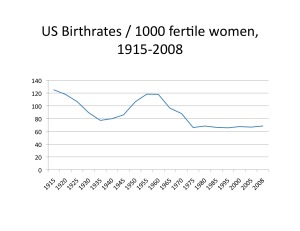
For today, I’ll back up a bit, and point toward prognostications issued in August about the falling birth rate in 2008 and 2009. The National Center for Health Statistics tells us (here), in preliminary stats, that the rate fell from 69.2 births per 1000 fertile women* in 2007 to a mere 68.4 in 2008. That’s a little lower than the 68.7 that held in 2006, which was a big 2% jump from the year before.  The New York Times reports that preliminary statistics for the early part of 2009 document a continuing downward trend.

The ups and downs in the birth rate can be a bit confusing out of context — is .8% a lot or a little? So here’s a chart of the US rates over the past century, based on CDC data (for some reason I couldn’t make it show the 1910 data, which is 1.8 points higher [126.8] than that in 1915). 1910 is as far back as they go.

US Fertility Rates, 2915-2008

As you can see, the ups and down since 1975 have been minimal compared to the swings experienced across the preceding six decades (due to things like world wars, the Depression, the baby boom, and the arrival of hormonal birth control in 1960).

The Times story links the decline in both years to the recession — not surprising given the effect of past recessions seen above.

Will women who’ve waited for babies for career reasons now also delay further for the recession, given the dicey fertility context?

And to what degree is the decline in the birth rate in 2008 (pretty early days for the recession) reflective of a decrease in births to teens, due to states’ turning away from abstinence-only education, with its attendant rise in rates for teens in 2007?

Hang on for the official 2008 birth stats from the CDC toward year’s end. Another nail biter!

How does the baby wave look in your house and neighborhood?

And in case you didn’t see it yesterday, here’s Judith Warner’s recent blog on how it’s time for the Times and other media to stop misrepresenting women’s “choices” around work and family — because that has distorting effects on public policy. You really think so?

*”Fertile women” are officially defined as the number of women in the population 15-44 years old, but the births included in calculating the rate also include all births to anyone who happens to have one before or after that age range.

Share

Childcare Progress

Here’s news of progress toward developing consistent standards and oversight mechanisms for childcare nationally. These funds wouldn’t add slots (though other programs may do that down the line), but they would pave the way to improving the quality of what care is available — an important factor per se and for making child care an option for many parents who need it but don’t employ it because they can’t find good, affordable care.

Initiative Focuses on Early Learning Programs
By Sam Dillon
New York Times
Sept. 19, 2009

Tucked away in an $87 billion higher education bill that passed the House last week was a broad new federal initiative aimed not at benefiting college students, but at raising quality in the early learning and care programs that serve children from birth through age 5.

The initiative, the Early Learning Challenge Fund, would channel $8 billion over eight years to states with plans to improve standards, training and oversight of programs serving infants, toddlers and preschoolers.

The Senate is expected to pass similar legislation this fall, giving President Obama, who proposed the Challenge Fund during the presidential campaign, a bill to sign in December.

Experts describe the current array of programs serving young children and their families nationwide as a hodgepodge of efforts with little coordination or coherence. Financing comes from a shifting mix of private, local, state and federal money. Programs are run out of storefronts and churches, homes and Head Start centers, public schools and other facilities. Quality is uneven, with some offering stimulating activities, play and instruction but others providing little more than a room and a television.
Read more.

Share

Domestic Product under Fire

slide_1705_23194_large1
Lately the Gross Domestic Product (GDP) – that measure of economic activity so often viewed as an indicator of national well being – has been coming in for criticism (from, among others, no less a personage than the President of France), along lines not so different from those that inspired this site:

It counts up the money spent (the total values of good produced and services provided in a country during one year), but it doesn’t consider how it was spent (dollars expended on disaster remdiation don’t signal improvement in national well being over the year prior) nor does it account for unpaid care work, which is a major factor in the well being of all citizens.

The chorus of critique emerges now because global warming and the current financial crisis make clear that short-term business profits, which are made to look like gains in wellbeing when they’re included in the GDP, have cost our environment and our long-term economy dearly. We need a system that will also reflect the negative effects of doing business, instead of seeing all business as pure positive.

French President Sarkozy (seen here with caregiver Carla Bruni) commissioned a report by two Nobel prize winners (Joseph Stiglitz and Amartya Sen), to make recommendations on alternative means of measuring economic and social well being (click here for the report, including executive summary). They conclude that the matter needs more study, but in the long run will need to include a number of measures, rather than just one, which will then need to be aggregated in order to accurately gauge well being.

An op-ed from a few weeks back by Eric Zencey, makes related points (rather more briefly): click here to read.

How does women’s work fit into this debate? Stay tuned for the next installment….

Share

Singing Sisterhood

Beyoncé and Taylor

Beyoncé and Taylor

Big sister Beyoncé (winner of the video of the year award) stood up for her younger sibling in the singing sisterhood at last night’s Video Music Awards – giving Taylor Swift (winner for best female video) the chance to finish her acceptance speech interrupted by Kanyé West earlier that evening, and comparing Taylor to her own younger self at the VMA’s at 17.

Here’s how it happened:
Kanyé interrupts

Beyoncé stands up

Beyoncé doesn’t just talk sisterhood here, she sings it as well, using her platform to look hard at modern love. Her winning song Single Ladies makes a case for marriage and commitment in a world where 39% of US babies are born to unmarried women, asking both the single ladies and gents in her audience to think it over.

After Taylor’s quick costume change between her two “moments,” the two stars do look a lot alike.

Here are the songs the sisters won for:
Single Ladies (Put a Ring on It)
You Belong with Me

Share

Women’s Labor and Infertility

Women’s Labor and Infertility

We ladies have a special relation to the word labor–it names the work we do for pay outside the house, the work we do for free at home, and that transitional, and frequently painful, hard physical work through which many of us directly produce the next generation for the nation.

The relation among all three realms of women’s labor has been in flux for decades. New farm technologies and our expanded life-spans mean the world just doesn’t need so many babies. Our understanding of women’s work has been especially mobile since the arrival of hormonal birth control in 1960, in concert with rising education and employment options.

Given the choice, women and their partners have opted to have fewer kids, delay their arrival, or decide against them altogether. Released from old biological constraints, women have flooded the universities and climbed career ladders, redefining “women’s work” by expanding it to include just about every field of endeavor, and doubling our national talent pool.

Absent supportive work policies, delay of kids has provided a shadow benefits system. Many women waited until their salaries and their on-the-job clout had grown and they could negotiate family-friendly schedules they wouldn’t have been able to get earlier on. As a result of their trickle up, women as a group have a new status in policy discussions, a status directly linked to their use of contraception to delay the arrival of kids–-some by a few years, others by many.

In 2007, 612,000 babies were born to women 35 and over (that’s 1 in every 7 babies), of which 105,071 were to women 40-44 and 7,349 were to women 45-54 [up from 1,375 20 years prior]).* But while some delay works for most, long delay brings difficulties.

Fertility wanes, and especially quickly between 40 and 43. But the desire to form a family often increases with age, especially now that women can hope to continue fit and healthy into their 80s; they’re better off financially; they’re more likely to be in a long-term relationship; they’ve accomplished many of their work ambitions and are ready to focus on family. Though they’re ready, their bodies don’t always cooperate.

In 15 states, women who encounter infertility for whatever reason** get some degree of insurance coverage for treatments – variously including IUI, IVF and egg donation, on a model similar to health-plan birth coverage. The infertility advocacy group Resolve states on its website that two thirds of infertile couples who seek medical intervention end up with a birth. In addition, many infertile couples and singles build happy families through adoption, while others end up without kids though they had hoped to have them – a situation full of ongoing sadness even when the people involved do move on to a revised life plan with happiness of its own.

In states that mandate full coverage, the average addition to everyone’s annual health bill was $3.14 in 1995, made low through economies of scale. In the other 35 states, you’re on your own and prices are high. Some can afford to pay $12,000 each for an IVF cycle or two, others can’t.

But society as a whole benefits when all citizens who want them can have kids when they’re ready–at the most basic level because we need a next generation of workers, but at another level because we want our citizens to be happy–for charitable reasons and more pragmatically because families are often what people work for, at whatever point they start them. In the end, it’s all about the labor force. Do we want educated couples excluded from the group of parents? Among those who encounter infertility, do we want only people who can afford the high cost of treatments to procreate?

In the past 50 years women have expanded their contributions in the workplace, and their education has grown the human capital of the nation. If sufficient numbers of women trickle up and change government support systems and business practice, future generations won’t have to delay in order to have both a family and a career to support them, though they may delay for other reasons.

There are lots of complexities to the modern fertility scene, and there’s plenty of room for misuse of new technologies as well as positive use. Which is which may not always be clear at first glance. As we move forward with health care reform, the expansion of infertility insurance to meet the needs of our expanding group of citizens who want to start their families later as well as people who encounter infertility from all causes should be part of the discussion, within a wider culture of care that assumes that all our citizens and families deserve basic supports, because we are our common wealth.

*The US birthrate to women 35-39 was 47.5 in 2007 and 26.2 in 1987; to women 40-44 it was 9.5/4.4; and to women 45-54 it was 0.6/0.2 (the rates are figured per 1000 fertile women).

**Female infertility isn’t just about delay–it can occur in younger women as well and is linked to increases in STDs, to PCOS (polycystic ovary syndrome–think Kate Gosselin), to endometriosis, to male factors, to environmental toxins, stress, and to other, unknown factors.

Share

What’s It All About?

Welcome to DomesticProduct.net – a new blog exploring the evolving dynamics of women’s work, at home and outside it, just in time for Labor Day!

Tension over what properly constitutes women’s work is the crux of much of our current public discourse. That tension feeds the babble about baby bumps that fills the celebrity magazines, lies at the root of our fair pay disputes, and of our struggles over access to abortion and birth control. The 2008 election operated in part as a labor debate over what kinds of jobs women are allowed to hold (president or clothes presser, in one formulation). The endless stories on fertility, birth timing and Mommy Wars play into the debate as well.

Ever since the advent of hormonal birth control in 1960, the social fabric woven over millennia around the assumption that women were baby machines has been undergoing quick redesign throughout the world. And stirring plenty of controversy. (see Never Done and Under Paid for more on this)

It’s taken a while, but gradually women are trickling up into policy-making positions in business and government. Once there, they’re beginning to change the rules—and to move us toward a culture of care that recognizes the importance of supporting families—incubators of that most domestic of products, our citizens—at the same time that we develop work systems that allow women to contribute fully to the Gross Domestic Product in the workplace. (see Remember Mama for more on building a culture of care). But there’s far to go yet, and it’s a long process!

I’ll be posting my thoughts on some of the many sides of this big and ongoing cultural shift, along with links to related stories. Your thoughts and stories welcome!

Share