Just the Facts, Ma’am: Later Childbirth and Autism (a debunk)

Hot on the heels of last month’s fertility scaremongering about ovarian reserve came a new scare for women planning to start their families later, this one about autism. Once again, reporting on it ignored essential facts and skewed the takeaway.

The recent UCDavis study exploring the effect of parental age on the likelihood that a child would be autistic made headlines. “Study: Older Moms Risk Autism in Children” Time told us, reprinting the AP story; “Autism linked to older moms,” echoed many others. That’s the line the 28-year-old I ran into that day parroted back to me, worriedly. One NY Times blogger directly linked discussion of the increased odds for autism with maternal age to a questionnaire about the best age for having kids. Talk about a (mis)leading question.

But while the study, based on 4.9 million California births in the 1990s, documented that the risk of autism increases with maternal age by 51 percent and that paternal age is also a factor, few of the reports asked the key question “51 percent of what”? If the risk at 25 is low to begin with, then adding on another 51 percent doesn’t change things much.

And it is low: less than one quarter of one percent of the 25 to 29 year olds in the study had an autistic child, and while the odds increased by 51 percent for women 40 and over, that meant that less than one half of one percent of the older women had autistic kids. As Janie Shelton the study’s lead author put it, though they have a very slightly greater chance than younger women, “older women have a dramatically small chance of having a child with autism.” But that was not the takeaway for most readers.

The authors also found that advanced maternal age was the cause of just 4.6% of the 600% rise in reported cases of autism in the 1990s. That means that less than 1 percent of the total autism rise was due to maternal age.

While the headlines are technically accurate, they create a major false impression. Older mothers do not regularly have autistic children, though some do, as do some mothers at all ages. Genetics as well as environmental factors, many of which are currently hotly disputed, play much bigger roles in causation. And older mothers may simply be better at navigating the complex system required to get a state diagnosis.

Missing Context
What’s missing in this story, as in the ovarian reserve story, is context. Saying that maternal age creates a 51 percent rise in risk of autism at 40 means nothing if you don’t also explain what the original risk was. Talking about an abstract proportion of eggs a woman has without discussing how many are actually needed is similarly pointless. Unless the point is to confuse people, create anxiety, or push them to have babies whether or not they feel ready for them.

A few media outlets were more even-handed on the autism story (the LA Times and CNN were the most thorough of the stories I saw–though their headlines still spread skew). But overall, delay of motherhood, by a few years or by many–a trend that is overwhelmingly responsible for allowing women to invest in their educations, climb career ladders and begin to have a role in business and government policymaking –gets a bum rap in this kind of coverage.

Selective presentation of “facts” creates big misunderstandings, in the fertility realm as in all realms. Time for reporters to do more than rehash numbers that come in over the wire, and actually put the data in perspective. Until they do, time for women to be skeptical of everything they hear about fertility on the news – if they aren’t already.

This originally appeared on RH Reality Check.

Share

Womentoring = the way up for all

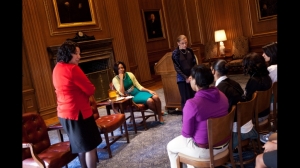
First Lady Michelle Obama watches as Justices Sonia Sotomayor and Ruth Bader Ginsburg mentor young women at the Supreme Court

First Lady Michelle Obama watches as Justices Sonia Sotomayor and Ruth Bader Ginsburg mentor young women at the Supreme Court


Here’s a great photo worth thousands of words, reminding us that the work of getting women’s voices actively into the making of the public policy that re/writes the rules we all live by is actively going on at all levels — from anti-abuse advocacy to mommy blogging to union halls to book groups to board rooms to the Supreme Court.

Keep it going!

Share

International Women’s Day #99 / Moving forward

IWD started back in 1911 – and a lot has changed in the interval. There’s plenty yet to do, but many more women now work in places where they can get the message out. Like India Gary-Martin (b. in Ohio, now a senior banker at RBS in London and President of the City Women’s Network)

India Gary-Martin Discusses Women in Senior Business Roles

“If [business] people don’t make it happen, then the government has to make it happen. … We should be able to make it happen without legislation.”

The time for positive change is always now.

Share

25% of Iraqi Seats Must Go to Women

That’s 82 seats.

From <em/>Sisters in War: A Story of Love, Family and Survival in the New Iraq” title=”christina_asquith” width=”300″ height=”196″ class=”size-medium wp-image-450″ /><p id=From Sisters in War: A Story of Love, Family and Survival in the New Iraq

Hear more on the story from journalist and author Christina Asquith on NPR.

Then ask yourself how this connects to the United States, where currently 17% of the seats in Congress are held by women, with no guarantees on continuation.

There’s growing global sentiment for recognizing that women’s interests and insights are ignored when they’re not at the public-policy-making table (see French Gender Quotas piece, for example).

When / does the “no legislation without representation” concept hit home? While many elements differ in the US and Iraqi scenes, is the basic dynamic essentially different? Calling Lani Guinier?

Share

The End or a Shot in the ARM?

Earlier this week Andrea O’Reilly announced the closing of her Association for Research on Mothering at York University in Canada, effective May first, due to lack of funding from York.

The sudden closure could mean the end to a long and productive series of conferences and publications on issues related to mothering around the globe. But ARM’s supporters are working to turn things around, with a new facebook page and a fundraising effort.

“Motherhood is such invisible work and ARM made it visible,” notes one supporter in the Toronto Star.

Will the mothers save the ARM? Stay tuned….

Share

Budgetting for Childcare – the Big Picture

The current federal budget discussion includes several moves toward expanding access to good, affordable childcare.

Not only would this access improve our national education outcomes and women’s ability to go to work, earn full-time salaries and benefits (instead of being ghettoized in low-paid, reduced-benefits part-time work).

In addition IT WOULD CREATE JOBS — in the centers. Good jobs, with benefits and a decent wage. Since those jobs would be in GOOD childcare situations, they would require skilled workers, which would lead to further increase in educational levels, this time for those seeking to fill those jobs.

Win win. In discussing the benefits of childcare, it’s key to keep all these linked effects in mind and in the discourse. Childcare = improved EDUCATION for kids, HIGHER lifetime WAGES for the women workers whose kids are in the childcare and for their families, more access to health care for families, improved education for the teachers, and many new good, unexportable JOBS (if expanded to full access for all who want it, hundreds of thousands of such jobs).

Related post: Childcare as Infrastructure: Minting the Common Wealth

Here’s a summary of what’s been proposed by the Obama adminstration, from the National Women’s Law Center:

• A $1.6 billion increase for the Child Care and Development Block Grant (CCDBG), to a total of $6.644 billion. This would be the largest increase in funding for the program in more than 20 years. The increase would include $800 million in discretionary funds (which are appropriated on an annual basis do not require a state match) and $800 million in mandatory funds (which require a state match). Mandatory funding would be adjusted each year for inflation after FY 2011.

The additional funding for CCDBG would allow for an increase in funding set aside for quality improvement activities, to $373 million (from $271 million), of which $137 million would be for activities that improve the quality of infant and toddler care (up from $99.5 million previously). The set-aside for child care resource and referral and school-age activities would be increased to $26.09 million (from $18.96 million). Funding for the Child Care Aware toll-free hotline would remain at $1 million.

The Administration proposes to use the additional CCDBG funding to support a reauthorization of the program that would encourage the establishment of a high standard of quality across child care settings, expansion of professional development opportunities for the child care workforce, and coordination among early childhood education programs.

• A $989 million increase for Head Start and Early Head Start, for a total of $8.2 billion. Head Start would serve an estimated 971,000 children, an increase of approximately 66,500 children over FY 2008, and Early Head Start would serve approximately 116,000 infants and toddlers, nearly twice as many as were served in FY 2008. This allows for the increased number of Head Start and Early Head Start children funded by the American Recovery and Reinvestment Act (ARRA) to continue.

• Approximately $9 billion over 10 years for a new Early Learning Challenge Fund, similar to the amount included in a bill passed by the House last year and that will be debated by the Senate. The initiative would make competitive grants to states to improve the quality of early learning programs to help children enter kindergarten ready to succeed.

• A $10 billion increase over 10 years for child nutrition programs to support their reauthorization, including the Child and Adult Care Food Program.

• An $87 million increase, to $1.3 billion, for U.S. military child development centers to expand availability for affordable, high-quality child care services at over 800 centers both in the United States and overseas.

• An increase of the Child and Dependent Care Tax Credit for families earning $115,000 and under. Families earning $85,000 and under would be eligible for a tax credit equal to 35 percent of child care expenses, with the percentage phasing down to 20 percent at $115,000. However, the credit would not be made refundable, so families with little or no federal tax liability would receive little or no benefit.

At the same time, funding for several other child care and early education programs would be frozen at existing funding levels, consolidated with other programs, or eliminated:

• Funding for Individuals with Disabilities Education Act (IDEA) Part C Grants for Infants and Families and Part B/Section 619 Preschool Grants would remain at $440 million and $374 million, respectively.

• Funding for Child Care Access Means Parents in School (CAMPIS), a competitive grant program supporting the participation of low-income parents in postsecondary education through campus-based child care services, would remain at $16 million.

• Funding for 21st Century Community Learning Centers, which supports before- and after-school opportunities for children, would remain at $1.166 million.

• A new $250 million Striving Readers literacy program would consolidate a number of existing programs into a comprehensive birth through high school literacy grant program. Fifteen percent of funds that state educational agencies subgranted to local agencies would have to be used for serving children birth to kindergarten age. Even Start would be eliminated as a separate program.

*Note: Proposed funding levels for FY 2011 are compared to FY 2010 funding levels excluding any additional funding provided through the American Recovery and Reinvestment Act, unless otherwise noted.

Share

Adoption think

Nice adoption trip post by PunditMom — and a series of good ones on Haiti from Adopt-a-tude. Harlow’s Monkey is an ongoing source of critical reflection on the world of international adoption from the perspective of an adult adoptee.

Adoption is complicated, as these blogs attest. Respect, personal and cultural, is the best foundation–and the world’s understanding of the dynamics of adoption (international, in-country, transracial and not) and of the effective responses to the needs of orphans and kids whose living parents can’t provide for them are evolving quickly. No easy answers but lots of room for the hard work of love and real family support.

Share