Delayer Boom!

The June 2010 Census fertility survey is yielding data now, and today’s headline tells us there’s a “’Delayer Boom’ as More Educated Women Have Children Later.” Not a surprise here, or really not a surprise probably anywhere by now. But good to have the documentation.

Here are the charts.

Since women are increasingly having kids after 35 and 40, it’s not a complete portrait of what women will do to look at women 35-44 as a group and assume they’ve pretty much all had all their kids. Many of them will have more. So the chart is showing you there is a delay effect, but doesn’t quite tell you the full story, because they don’t have data on women at 45 and over, when they are pretty much finished bearing [though that’s going to be less and less true, as the egg-donation (way-delayer) boom is on the way].

The recessionary effect also plays in — birth rates have been down in the last few years in all age groups below 40, so the rate among women 35-39 is lower than it would otherwise have been, and not reflective of what will be the long run trend if the economy recovers.

All this affects the study’s conclusion that women with a college degree or more will end up with around 1.7 kids, as opposed to women with less than a high school degree with 2.5 kids. Increasing numbers of women, many of them with BAs and more, are having kids in the 40-44 range every year (see story on the 2009 data below). And of course none of this data includes adopted children. Stay tuned!

Share

A Dose of Pro-Natalism for Mother’s Day: What’s Up with That?

Lately birth rates have been down: 2009 and 2010 birth data indicate that the US birth rate is diving under recession pressure (except for moms 40+), and 2010 Census data indicates that while the population has grown in the past decade, “new” minority kids (Hispanics, Asians, etc) have been born at a rate much higher than white kids, predicting a much browner future for America. Births to blacks are also down (though not as much as to whites).

In the wake of this news, we have two new books out calling for MORE BABIES. Bryan Caplan’s Selfish Reasons to Have More Kids: Why Being a Great Parent Is Less Work and More Fun Than You Think makes the case that parents overdo it with the intensive parenting – since twin studies show that nurture (apart from good enough provision of the middle class basics) plays a small part in the success and happiness rates experienced by adults. So we could all do less high-stress intensive care giving, which would make parenting more fun.

Caplan then reasons that, if having kids becomes more relaxed and fun, we should have more kids (risking losing the benefit of the relaxed parenting, one might guess, since basics provision actually does involve some effort and expense, which does expand with the number of kids). Because?? Because, long-term, they will give us more grandchildren when we’re old, and contribute more to our care and support. And, by the way, staff the jobs of the future. And, by the way, staff those jobs with white people, given that his audience is people who are having fewer kids. Population/environmental problems? We can solve them easily with a global carbon tax, Caplan reassures readers. No discussion of how to go about getting that global agreement in place.

Like Caplan, Kasey Edwards, in a book out in the UK but not yet in the US, addresses the fact that many people are finding it too hard to have kids, given the tradeoffs in the work world it often involves, and choosing either to have fewer or none. Her story, Thirty Something and the Clock Is Ticking – is set in Australia, where the birth rate is lower than in the US (1.78 TFR, vs 2.06). At 32 Edwards was told by her doctor that her endometriosis was wreaking havoc on her lady parts, and that she’d better act fast if she wanted a family. So she and her beau did that, employing IVF along the way, although kids had not been in their plans at that point. She now has a baby girl. While in the process of conceiving she (already the author of Thirty Something and Over It, a consideration of the disappointments of modern work) spoke with a lot of her fellow travellers, and other people with opinions about parenting (that gives you a pool of just about everybody). Her takeaway: people should start families sooner and find ways to fit kids into their lives in spite of the difficulties.

Since this book is not out here yet, I’ve had to rely on British reviews and Edwards’ website. They suggest that Edwards is interested in the complexity of people’s experience (there’s evidently a lot of consideration of why people might find the job of mothering less than attractive). But the book seems also to skew data on fertility toward the frightening (most people do not have end-game endometriosis at 32). “It’s really hard to get pregnant in your thirties,” says Edwards on Irish TV. But in fact that’s not true for most. Saying that women at 30 have a 22% chance of getting pregnant per month, and that by 35 it’s down to 18% sounds a lot worse than the more big picture data like – 7% of women who try do not get pregnant within one year at 30, 11% at 35, 33% at 40, 50% at 41, and 87% at 45. There is an obvious decline over time, and people need the facts, but it’s not necessary to alarm young women – except that alarm always makes good media fodder.

And could lead to the birth of babies sooner than their mothers would otherwise have thought of doing. Fine enough if they’re happy with that outcome, but there’s no attention paid in these texts to the workplace problems that lead women to hold back on kids nowadays to begin with. Women who start sooner are stuck with lower wages, and a slow down in the trickle up of women into policy making roles in government and business – the lack of which, circularly, creates the problems that women face at work….. And some people seem to think they have an interest in preserving that status quo.

Pronatalism (basically, promoting more births) serves a variety of purposes, which you may variously like or not – but be on the look out in the coming months for texts that claim to be pushing babies on you for your benefit. There may be other logics at work and groups seeking to benefit as well.

On related work/family ground, but from a different direction, I’m looking forward to reading Bossypants, by new later mom Tina Fey, now pregnant at 40 with baby 2, as soon as the semester sunsets.

Happy Mother’s/ Mothers’ Day everybody — moms and non-moms, dads and non-dads, as you like it.
And feel free to circulate copies of Ready: Why Women Are Embracing the New Later Motherhood among your friends and relations if you’ve already got your copy, to balance out the ever-present birth timing conversation.

Share

Fertility Up, among women 40+

slide11
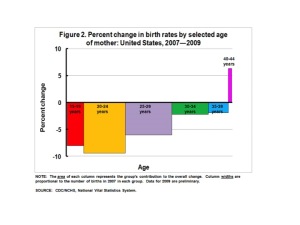
Data can always be variously interpreted.  This chart was published as part of a report called ” Recent Decline in Births in the United States, 2007-2009.”  And clearly the overall rate is down, as are the specific rates in most categories.  But not all.* Births to women 40-44 were up 6% overall in the past two years (3% per year).

The decline is generally tied to the recession — though this report does not discuss cause.

The suspenseful part for demographers: What will follow? When/if there’s an economic upswing, will births resurge, and will the effect ripple upward across age brackets (will women who would have liked a first, second or third child during the recession but refrained from childbearing in, say, the 35-39 age band go on to have that child in the 40-44 age band, or similarly will those who delayed at 30-34 pay it forward in the 35-39 band, and so on)?

Women who are currently in the 40-44 age band obviously are not delaying. In fact, they may be previewing the answer to the prior question –since the recession is already several years old, and a good proportion of those in the 40-44 band may well be women who were open to delaying in their 30s, but not in their 40s (a point when women often feel pressure to act fast). If the recession ends and a resurgence in births follows, it will combine the demand of people who didn’t want a child prior but now do and feel free to act on that wish, with the pent up demand of women who delayed.

Births to women 45-54, almost entirely due to donor eggs, were up 17% in the period. These are not on the chart, presumably because they were so few relatively speaking (7,934 in 2009, up from 3,722 in 1999). This is also an age band with potential for dramatic increase, though the actuality is entirely unpredictable.

Here’s the link to the full report

*The same trends are noted in 2010 birth data through June, but it is not broken down by age of mother.

Share

Helen of Troy: Some of Women’s History Should Stay That Way

helen-of-troy
March is women’s history month, but this year we’re getting a special kind of history lesson. The anti-woman agenda being ram-rodded through legislatures this term is ancient. At least since Helen of Troy, our leaders have been actively denying women the right to choose how to run their private lives.

The Greeks fought a long war to prove that we had no such right, and wrote it up in the Iliad. The gender lesson was a major plot point—as Helen, half goddess, was forced to return to Sparta with Menelaus, the husband she didn’t love. Men’s right to philander, on the other hand, was affirmed in that poem and its sequel (recall Briseis, Calypso and Circe). Penelope read that memo, and the rest is history. The history, specifically, of patriarchy—the rule of the fathers over the mothers and the young.

That history had much to do with guys controlling women’s fertility in order to leave their property to their genetic heirs. The romance plot was always economic at base. Other economic effects included ensuring the proliferation of farm workers and soldiers and getting the household care work done for free. In the past, women’s lack of wages and thus of civic influence, and their preoccupation with the housework that was “never done,” meant they had no voice in public policy, despite comprising half the populace.

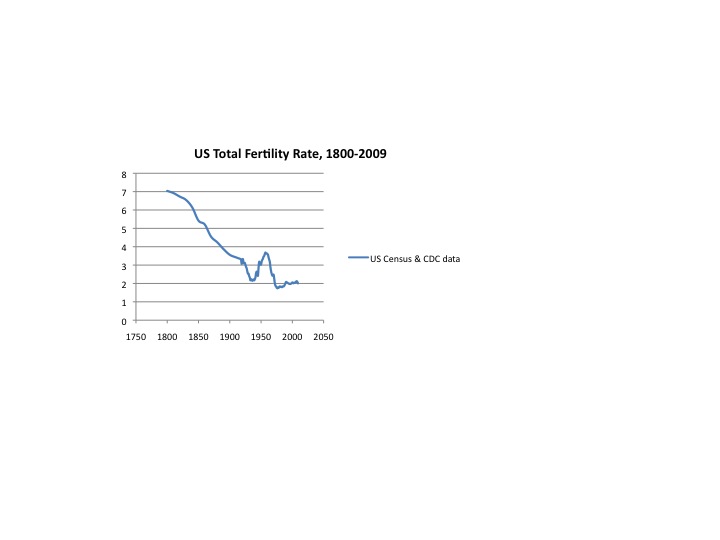
But birth control changed that. Goodyear’s vulcanization of rubber in 1839 was pivotal, as was the development of hormonal birth control in 1960. While in 1800 the average US woman had 7 kids, in 1900 she had 3.5. The Depression (also a contraceptive) drove the number down to 2.1. It rose to 3.7 in the Baby Boom, then plummeted after 1960, hovering around 2.0 since the seventies.
tfr1800-2009Birth control arrived when new technologies cut the need for hordes of harvest hands. Lifespans average 30 years longer. The world is crowded. And for men anxious about their progeny, we have DNA tests. Confining women to the home makes no economic sense anymore.

Radically, birth control moves women into public life for the first time in recorded human history. Women can earn and spend money, contribute skills and innovations to the commonwealth, and shape policy. Female representation in Congress has risen to new heights, though that’s still a rather measly 17%.

This democratization makes sense to many, but it doesn’t sit well with some displaced or would-be patriarchs, who don’t like sharing. Hence the effort to turn back the clock, by defunding Planned Parenthood and cutting off access to contraception and abortion, along with health care, for many women.

No matter that the decreased education and earning power this creates adversely affects the US economy as a whole, gutting our potential for innovation. De-novation is the point. The anti-woman atmosphere clouds the lives of all female citizens.

Some attribute a racist agenda to the push to deny young women birth control – a reversion to compulsory childbearing in order to ensure the production of more white folks; and that may be a factor. But this agenda would push women of all colors back to the kitchen.

That’s pretty scary – but it’s also weirdly encouraging. The ferocity of the push back indicates that the 17%, and the several generations of educated women they represent, are having effect. Though there’s still far to go, change is underway.

But real transformation, around the world, takes time and long-term commitment, through what will be many and epic battles over resources of all kinds. Recessions have historically undermined social advances, as every man is suddenly out for himself and budget cuts serve as cover for partisan attacks on progressive programs.

To keep change going, feminists male and female have to speak up vociferously, to open our pocketbooks, and to vote year after year for the candidates who will continue to move us forward, many of whom will be women. Because if women’s voices aren’t directly part of the decision-making, the decisions too often do not reflect our interests. Not many women’s voices in the Iliad.

We carry some positive legacies from the Homeric past, but there’s a lot in those epics we’ve moved on from. The poems themselves, born within a shifting oral tradition and flash frozen by the invention of writing in the West, tell a story about the inevitability of cultural and technological change over time.

Often Women’s History Month is the occasion to celebrate women of the past. But there’s a lot of women’s history that doesn’t deserve celebrating or returning to. It’s up to us moderns to give the Helens of Troy Michigan and of all our hometowns full access to the policy table. That can only happen when we stand up for women’s control of their own bodies and for affordable family planning for all, constructing new gender plots for our very different times.

This post first appeared on RH Reality Check.

Elizabeth Gregory is the author of Ready: Why Women Are Embracing the New Later Motherhood, and “Unravelling Penelope.”


Share

Deaths down: -2.4% for 2009

Good news on the death front: people of all races and genders are living longer. Overall, minus 2.4% in 2009 vs. 2008.

Of course, when you look at the details, the story reads better for some than others. Citing the study:
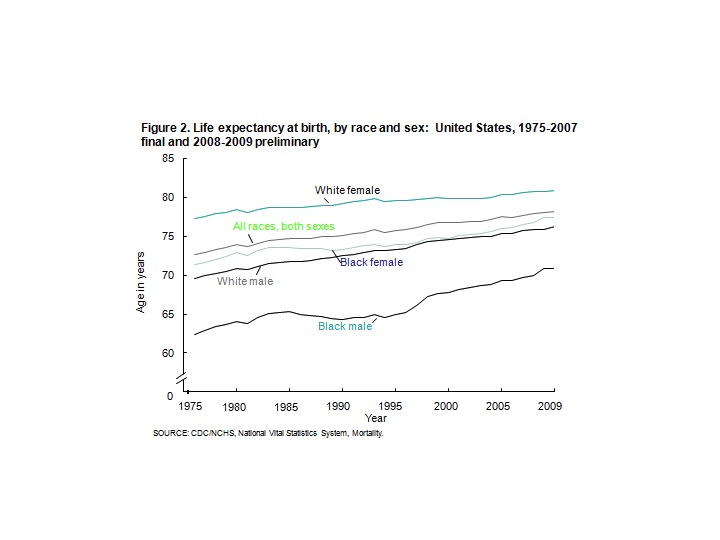
The age-adjusted death rate decreased from 2008 to 2009 by 2.8 percent for females and 1.4 percent for males. (Life expectancy for males rose to 75.7 in 2009, and for females to 80.6.)

White females have the highest life expectancy (see Figure below), followed by, in order, black females, white males, and black males. Figure 2 also shows that this pattern has not changed from 1975 through 2009, even though life expectancy for all groups has generally increased over this time period.

From another angle, the percent decrease in death rates was highest among 1 to 4 year olds (down 7.7%), followed by 15-24 year olds (down 6.7%), then 75-84 year olds (down 4.9%) and those 0 to 1 (down 4.2%).

For full details: CDC Mortality Data 2009
lifeexpectancyUP2009

Share